
Wilson 1843
Charles Heath Wilson, Mr. Wilson’s Report, in: Second Report of the Commissioners on the Fine Arts, with Appendix, London [William Clowes and Sons] 1843, pp. 16–44.
APPENDIX
. . .
No. 3.
MR. WILSON’S REPORT.
[C. H. WILSON, Esq., Director of the Government School of Design at Somerset House, was, in the course of the last year, employed by Her Majesty’s Commissioners on the Fine Arts to proceed to the Continent to collect information relating to the objects of the Commission. Having been furnished with the necessary instructions he left England in August and returned in January last.]
IN the report on the state of middle-age frescos and other mural pictures, which I have now the honour to submit to the Commissioners on the Fine Arts, I propose in the first place to describe and consider the construction of the walls on which such paintings are executed, and then to proceed in order with the other portions of my subject.
Mural paintings were executed upon plaster of various kinds, laid upon walls variously constructed; several examples also occur of frescos which were painted upon plaster laid on lathing. The comparative durability of works executed under these circumstances will be explained by examples, but, in the first place, without reference to the injuries sustained from external causes.
It is not possible to commence with a description of the earliest Christian edifices in Italy; these monuments, in the Byzantine style, do not offer, as far as I know, any examples of painting of a date coeval with their erection; they were first decorated internally with mosaics; and the few remains of paintings, properly so called, in such buildings, have been so frequently repaired that they cannot be referred to as examples of ancient art. With regard to paintings, the date of which is assignable, and which have not been so repaired, the first to be considered are those executed on ashlar walls; these are sufficiently numerous to afford satisfactory evidence. The oldest examples are to be found in Italian Gothic structures, such as the church of Assisi, and the cathedrals of Orvieto and Siena: in the first of these churches there are numerous specimens of the earliest application of the revived art of painting upon walls; in the others instances also occur, which, although less important, may be adduced in illustration of the subject. A few general observations will be offered on the construction of these edifices, and of those subsequently erected as the Gothic style fell into disuse.
The interiors of the above-mentioned buildings are finished in fine masonry; the walls, externally and internally, have ashlar facings, and are hearted with rubble; and although Gothic architecture never attained to a high degree of excellence in Italy, the constructive principles of the Gothic architects are apparent there as in other countries, but not developed in equal perfection; and as there is, in the ornamental detail of edifices of the period, a constant struggle between the introduced Gothic taste and the tradition of the classic, the same struggle is I think discernible in the constructive principles. In some examples the walls are of marble, in others of stone, in others again of brick; but in every case the mere workmanship is very fine.
When, at a subsequent period, the ashlar walls of these buildings were covered with paintings, one, or at most, two, very thin coats of plaster were laid on, sometimes formed of lime and sand, at other times of lime and marble dust; and the pictures were painted upon these grounds. They were in most cases commenced when the plaster was wet; but as, from its thinness, such plaster would dry very rapidly, the pictures were finished in distemper, and therefore cannot be called frescos: and it may be inferred that this mixed art was a consequence of painting upon such thin coats of plaster, made so of necessity, as thicker coats would have destroyed the proportions of the building which were already completed in the stone or brick work: this is exemplified in the door of the Lady Chapel in the cathedral of Orvieto, the thin shafts and mouldings of which are covered with a coat of plaster (to receive the painting), kept as thin as possible to avoid destroying the proportions of these details.
The above are specimens of paintings on ashlar walls. A church of a still earlier date, namely, that of S. Miniato at Florence, affords an example of brick walls on which at a subsequent period pictures were painted: other examples of paintings on brick will be cited.
With the progress of the revival of classic taste may, I think, be remarked a declension in constructive skill, or at least the introduction of a very careless practice; the rubble and external ashlar facing being retained, while the internal facing is done away with, and plaster is substituted. We also find internal walls so built as frequently not to be at right angles with each other, sometimes not quite perpendicular, and in all cases very uneven on the surface; for these rubble walls are generally built of mixed and indifferent materials, the fragments, apparently, of former buildings, such as small stones, broken bricks, and even bits of tile.
Many fine works of art are painted upon walls built in this careless manner, and thus the unfortunate inequality of their surfaces, which has been so often remarked, and accounted for in so many ways, is readily explained; at times the inequality is increased indeed by the actual bulging of the intonaco; this again is the result of bad workmanship, as in most cases no pains were taken to give the intonaco a key to the mortar beneath: there are one or two curious instances of marking the under coat to give the finishing coat a proper hold, but the practice was not general.* These ill-built walls are frequently faced externally with marble, stone, or brick building of unexceptionable execution: it is therefore the more remarkable that no pains were taken to bring the internal wall to an even surface by means of plastering,† as could very easily have been done, and in fact as was subsequently done in some cases on equally bad walls, by the Caracci and their pupils.‡
* Neither the Germans nor the Italians score or mark the plaster to give the upper coat or intonaco a hold, but they use a precaution in Germany which is more effectual, by mixing rough gravel with the first coats; the intonaco has thus a sufficient hold. The Genoese adopt the same practice.
† The words plastering and plaster are used in the general sense; it is not to be understood that plaster or gypsum is mixed with the lime.
‡ It is by no means intended to be asserted that this would be good practice, since the plaster, when of unequal thickness, is apt to crack.
Pictures then are found on three kinds of wall: on the ashlar walls of Gothic edifices, on the brick walls of buildings of different dates, and upon coarsely built rubble walls of different kinds. To these are to be added frescos on lath, of which there are many examples in different parts of Italy.
EXAMPLES OF PAINTINGS ON ASHLAR WALLS.
The most important examples are those in the triple church of St. Francis at Assisi. The walls of the lower church are in all probability finished entirely in ashlar stone-work; all the parts that can be seen, that is, those parts not covered with paintings, are so; in those which are painted the pictures seem to be in tolerable preservation.
The upper church is painted everywhere. The walls are internally finished in ashlar; the stones are very small, and being of a red colour, they look from the pavement like bricks set on edge; the seams are not very close, thus affording an excellent key for the plaster, which for the most part is firm; it has however fallen away in great masses near the top of the church, but this is to be attributed to the infiltration of water from the roof; in the transepts, portions have fallen away lower down, possibly from the effects of damp also; and as regards the construction, there seems from this instance to be no cause to doubt the durability of work of this kind.
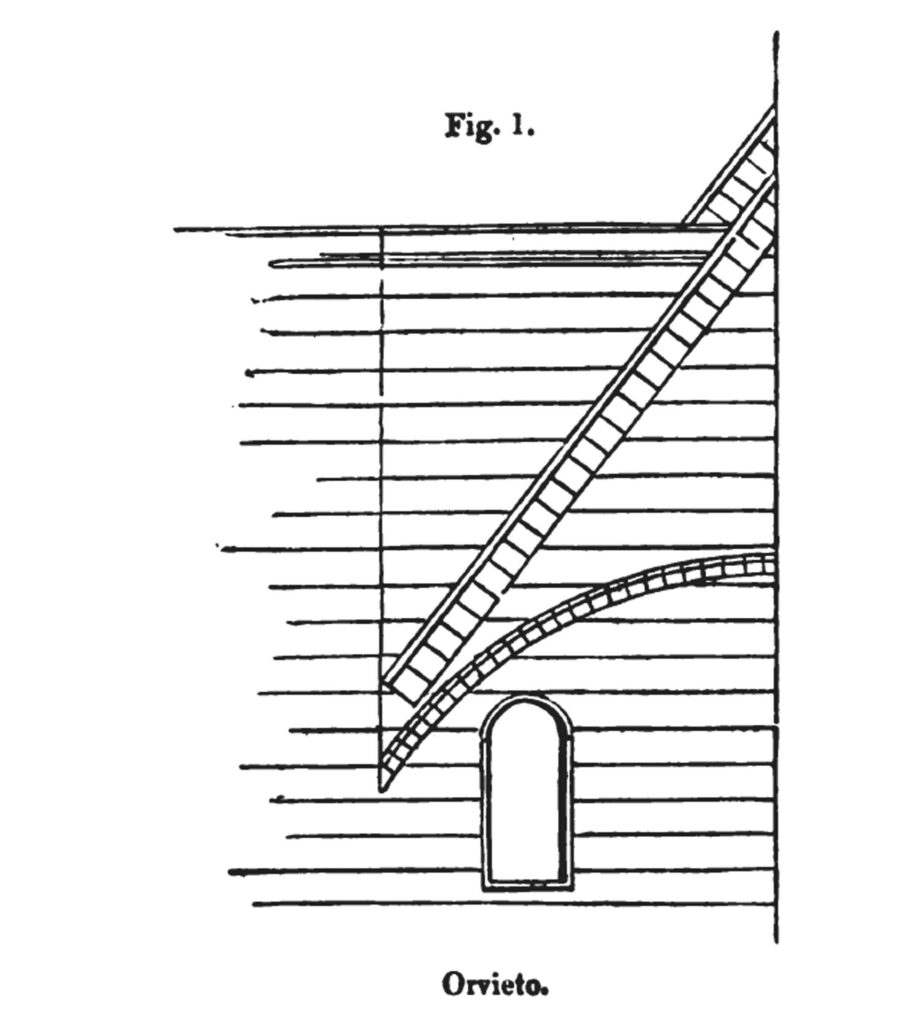
In the Chapel of the Sacrament at Orvieto the wall is of fine closely-jointed ashlar, the stones being of considerable size; the wall moreover is perfectly dry. The first thin plaster-ground has been scored in a peculiar manner while it was moist: the plasterer has taken the point of his trowel and made numerous circular marks so as to give a key to the intonaco, but as the first coat was applied to the smooth wall, the plaster has fallen down and but little remains. This example seems also to offer another lesson: the walls act as buttresses, resisting the thrust of the great transept arches, and their peculiar construction is exhibited in the sketch, fig. 1. One of the walls is more weakened by windows than the other, and the plaster has entirely fallen off in the direction of the thrust.
The plaster has also fallen off the fine stone-work of the doorway leading into the opposite chapel; and it is to be observed that the frescos of Luca Signorelli have a very uneven surface. The walls of the chapel present, externally, the same appearance as those of the chapel opposite, but they are a foot thicker, and an alteration has evidently been made in the window. It is not improbable that these walls were lined with a wall of tufo (on which frescos were frequently painted), the artist having perhaps thought it unsafe to paint on the ashlar wall.
There are some frescos in a small chapel in the Cathedral of Siena, painted upon plaster laid upon the marble wall; in this case the plaster has not fallen away, but there can be no doubt that in general the plaster is easily detached from ashlar walls. It may stand perfectly if not injured by damp or accident, but when injured it falls away in large masses, which is not the case with plastering on any other kind of wall. The frescos last mentioned in the Cathedral of Siena are very wet in warm weather, from the condensation of the damp in the atmosphere on the cold wall. This of itself is a great objection to the execution of frescos on such walls.
BRICK WALLS.
The pictures by Spinello Aretino in S. Miniato at Florence have already been alluded to as specimens of an early date and in perfect preservation. The wall is evidently dry, and being well built, the surface of the paintings is even and thus they are not injured by dust settling upon them.
The pictures by Giotto in the Chapel of the Scrovegni at Padua are upon brick; these also have an even surface, and although the colours have faded (possibly from the action of the light, as some of those on the same side with the windows are much stronger in point of colour than those opposite), it may be said that these pictures are generally in good preservation. Those on the vault have suffered from damp.
The library of the Cathedral of Siena, painted in fresco by Pinturicchio (in 1502-3), is probably lined with brick. The walls of the cathedral are, it is true, of polished marble inside and out, but this library was added in 1450 by Pius II., and is in the revival style entirely. The frescos are perfectly even on the surface, which never is the case with paintings of the period on rubble walls, and although it would be so were the plaster laid on ashlar, yet as the damp never condenses on their surface, as in the neighbouring chapel already quoted, these frescos may be adduced as instances of the durability of this kind of painting upon brick walls.
But we must look to vaulted ceilings chiefly for specimens of fresco upon brick, as the great majority are so executed, and on these in most instances the frescos are found in good preservation.
Pictures in the same situations in churches are, it is true, exposed to greater danger, there being nothing between the vault and roof, which is too frequently neglected; but in the Palazzi, where they have been properly taken care of, they are found to last perfectly well. The most remarkable in point of preservation are those by Beccafumi in the Palazzo Publico at Siena, which seem to be as brilliant as on the day when they were painted.
The Cappella Sistina appears to be a brick building externally, but Signor Bosio (“Architetto Camerale”) having been employed to examine the roof, thought from what he then observed, that the walls were built of tufo faced externally with brick; they are from eight to ten feet thick; whether there is any internal facing of brick for the frescos it is impossible to ascertain, but it is not improbable that the Last Judgment is painted on a brick lining, as its surface is much more even than that of the other paintings in the chapel. Those on the vault must certainly be upon brick, and are well preserved.
The frescos in the Farnesina, which are on brick, are in excellent order; and the fact that Carlo Maratta repainted the blue backgrounds is no proof that such a step was required. The presumption of this artist is painfully proved by the unnecessary retouching with which he has injured the frescos in the Stanze of the Vatican.
The frescos of the later Florentine masters, in the cloisters of several of the convents in Florence, are on brick walls; and except where they have been wantonly injured are in excellent order.
Of a later date there are the numerous frescos of the Caracci and of their scholars. In their time constructive care was exhibited; the workmanship is in every case excellent, the surfaces are smooth and even, and all their frescos are in good preservation, unless injured by accident. Those in the Farnese palace, St. Andrea della Valle, S. Carlo de’ Catenari, Sta. Maria Maggiore, and the Ludovisi and Rospigliosi Casini in Rome, – in numerous churches and palaces in Bologna and its neighbourhood, – in Modena, Piacenza, Parma, and elsewhere, may be instanced as proving the durability of fresco: all are on brick, and in all the plastering is excellent.
To this list, which refers to a considerable number of works, must be added the ceiling frescos in Genoa, nearly all on brick vaults,* and nearly all in perfect preservation. These paintings are chiefly by Pierino del Vaga and his followers, by Cambiaso, Carlone, &c.
* I have here to acknowledge a mistake in one of my communications (published in the First Report of the Commissioners on the Fine Arts) in which, misled by the extraordinary evenness of many Genoese vaulted ceilings, I stated that they were of wooden framework; some indeed are so, but the majority are of brick, and the remarkable construction of these is exhibited in the sections given by M. P. Gauthier, in his fine work entitled “Les plus beaux Edifices de la ville de Gênes et de ses Environs.”
RUBBLE WALLS.†
Unfortunately some of the most precious works of the great masters are upon walls of this description, and to this their dilapidated state is to be in a great measure attributed. There are instances of such extensive ruin that the cause of the unevenness of the fresco is evident, and it is probable that the same effect invariably proceeds from the same cause. It is quite out of the question to suppose that the wall behind frescos with solid but uneven surfaces, can be ashlar; nor are they likely to be brick, as examples which are certainly painted upon plaster laid upon brick are quite even on the surface, and the external facings of brick in the walls where these uneven frescos are found, are perfectly even. Nor does the unevenness in every case proceed from the bulging of the intonaco (which is easily detected by tapping with the finger), for frescos are often very uneven on the surface yet quite solid.
† By the expression “rubble walls” is here meant all walls chiefly built of irregularly formed stones, whether large or small, as well as other walls to be particularly described.
In the Chapel of St. Cecilia, in Bologna, the frescos by Francia and Costa are unhappily so much injured that the wall can be seen in several places. It is evidently of the coarsest rubble construction, and the frescos are very uneven on the surface. The walls of Sta. Maria Novella, at Florence, are of rubble stone, and the frescos in the choir present the same uneven appearance, as do those of Fra Filippo Lippi in the adjoining chapel.
The frescos by Avanzi in S. Giorgio, and by Titian and other artists in the Capitolo di S. Antonio at Padua,—by Masaccio in the Carmine, by Ghirlandaio in Sta. Maria Novella, and by Andrea del Sarto in the SS. Annunziata at Florence,—by Pordenone in S. Rocco at Venice, and in Sta. Maria in Campagna at Piacenza, have all very uneven surfaces, and all have consequently suffered from the accumulation of dust upon the inequalities, and from the cracking and breaking off of the plaster, partly owing to the bad masonry and partly to the careless way in which the mortar has been applied.
The inequality of surface observable in the frescos by Raphael and his pupils has often been remarked. I believe that this inequality is also entirely to be attributed to the manner in which the walls have been built, that is, of rubble alternating with courses of brick in the manner described by Palladio, under parts with even superior brilliancy. The works are chiefly distinguished by great clearness of effect, but are too slightly the head of “Muri di Cimenti.” Signor Bosio says, “Since the building of what may be called Modern Rome, the greatest carelessness has prevailed as to the material, execution, and finish of the masonry; and the same processes have been executed; the draperies may be said to be washed in rather than painted; still there is great mastery in the manipulation resorted to down to modern times. The best and most substantial walls are those entirely of brick, but being the most expensive as to material, lime, and work, such are very rare. The common mode is to build in alternate courses of brick and tufo – a coarse rotten-looking volcanic stone found everywhere in the Campagna, but which becomes harder on. The heads are very carefully executed, and parts of the flesh may be said to be perfectly painted; the extremities, exposure to air. Wherever the wall is to be thick the sides only are done in this way, the centre being filled in ‘a sacco,’ as it is called, that is, with lime and fragments of stone, brick, and rubbish of every description. These walls are thickly coated with rough-cast externally.”
“When a better appearance is required, for instance on churches, a facing of hewn travertine is applied to the basement story, and the mouldings of the upper stories are executed in the same material. The intervening wall-spaces being faced with coursed brick-work: as usual with this artist, are indifferently treated. There is much loading in the lights and a little hatching in this is rarely bound to the wall, and the Cancelleria, built by Bramante, is faced on the upper story with brick on edge; this work is called ‘cortina.’”
Signor Bosio superintended, as clerk of works, the erection of the Braccio Nuovo, in the Vatican, and on that and other occasions had opportunities of examining the walls built by Alexander VI. and other pontiffs, to the time of Sixtus V. These walls are of the class which has just been described, and are generally executed in a careless and insufficient manner. “Roman masons always rely much on thick coats of rough-cast, or plaster, to cover the irregularities and defects of their work parts, but freely and effectively introduced where he thought it might have an advantageous effect, unlike other frescos by Pellegrini in the same building, which are, and seem to have done so three hundred and fifty years ago; the impetuous spirit of Julius II. especially hurried works executed in his time; and to such an extent did this system prevail, that all the old foundations of the Vatican buildings are faulty. The ground which slopes towards the Tiber is of a yellow sand, on which these vast fabrics rest, and this sand is said to be ever moving downwards, although at an imperceptible rate; later additions have been secured by piling, which, when the Braccio Nuovo was built, was carried to the great depth of seventy palms.” The taste has been exhibited by the artist: he has not at all considered architectural propriety of design, but in other respects these foundations of the older buildings are carefully watched, but still the walls have suffered, and this sufficiently accounts for the bulging of the plaster in the Stanze, whilst the inequality of the surfaces of these works is explained by Signor Bosio’s account of the careless fabric of the walls.
Signor Colombo of Rome, who has much experience in early Italian art, has paid attention to this subject, and says that the Roman masonry, from the cottage to the palace, is the worst in Italy; he also says that in Lombardy the walls are frequently built of courses of brick and rubble.
The old practice of facing such walls as have just been described with brick is continued in Rome, and as there is no bond whatever between the wall and this facing, it sometimes tumbles down in great masses; it is also very objectionable from the unequal settlement that frequently takes place. An example on a great scale is found in the walls of St. Peter’s, which, about eight French feet in thickness, are so built as to constitute in reality three walls, the outer one being travertine, the centre one tufo, and the inner facing brick; it is found that these settle separately, and as the building is already injured, it is watched with much care and anxiety.
As in this first part of my Report I have proposed to consider the state of old Italian frescos, with reference to the architectural construction only, I have dwelt at some length on modes of building, from which no danger is to be apprehended by the fresco-painter in this country. Where such remarkable carelessness as to the quality of the masonry has been exhibited, instead of being surprised at the present state of the frescos, we ought rather to wonder that they are preserved at all.
Wherever due attention has been paid to the construction of the walls, pictures either are in excellent preservation, or their dilapidation can be accounted for from external causes which might have been guarded against.
The houses at Genoa offer examples of a different description of rubble wall; they are built of masses of slate which, being hard and brittle, are rarely squared with the chisel, and there are not many examples of their being wrought into mouldings or other architectural ornamental features. The masses are large, which constitutes the difference between this kind of wall and those last described. All such walls are plastered externally and are generally painted in fresco, mouldings and other ornaments being represented in chiaro-scuro, and the flat part of the wall being painted red, yellow, or green. Some palazzi are decorated with external frescos of historical and allegorical subjects. Taking the constructive principle solely into consideration, the fresco-painting of Genoa upon this kind of wall has stood well; but whilst the examples of paintings on surfaces of this description are not numerous, walls so constructed are, like ashlar, liable to the objection of the damp condensing on the pictures in peculiar states of the atmosphere.
From the observations which have now been made it would appear that plaster will stand upon ashlar walls, especially if, as at Assisi, the stones be small and the seams open; but if the plaster be loosened from this kind of wall by damp or accident, it entirely falls away in large masses, showing that it does not adhere firmly to the masonry. It is not to be supposed that frescos will be again painted upon such defective walls as the rubble walls first mentioned, but it may be noted that the plaster does not fall from such in masses, but rather crumbles down.
It seems evident, from the examination of ancient frescos, that brick walls are the best for fresco, and the practice of the careful Germans and modern Italians are in favour of this opinion. The evidence already collected by the Secretary, and published in the First Report, renders it unnecessary to pursue this subject further.
FRESCOS UPON LATH.
There are many specimens of frescos upon lath in Italy; the most ancient is that of the “Trionfo della Morte,” by Orgagna, in the Campo Santo of Pisa. The artist probably adopted the precaution from having entertained doubts as to the fitness of the walls of this edifice to receive frescos.
We read in Vasari that Giotto, when called upon to paint here, had the walls very carefully prepared; but his preparations were far from being sufficient, and his works, or those attributed to him, have nearly perished like most others in this celebrated edifice, that by Orgagna excepted, which is in good preservation. It is executed upon a lathing of reeds or stoja,* as the Italians call it.† The lath in this case is probably merely nailed to the wall without the intervention of standards, as the surface of the fresco is even with those of its immediate neighbours. It has been supposed that the sea air injures frescos; this prejudice is a very old one, but is here disproved. Had it been the sea air, and not the damp in the walls that had injured these frescos, Orgagna’s would have stood no better than the others. We may conclude from Orgagna’s precaution that that able architect saw where the real danger lay, viz. the damp which rises from the soil or infiltrates from the roof.
* For a description of this ancient mode of lathing, see the First Report, page 32.
† This was ascertained by MM. Signol and Orsel, distinguished French artists, to whom I am indebted for the communication.
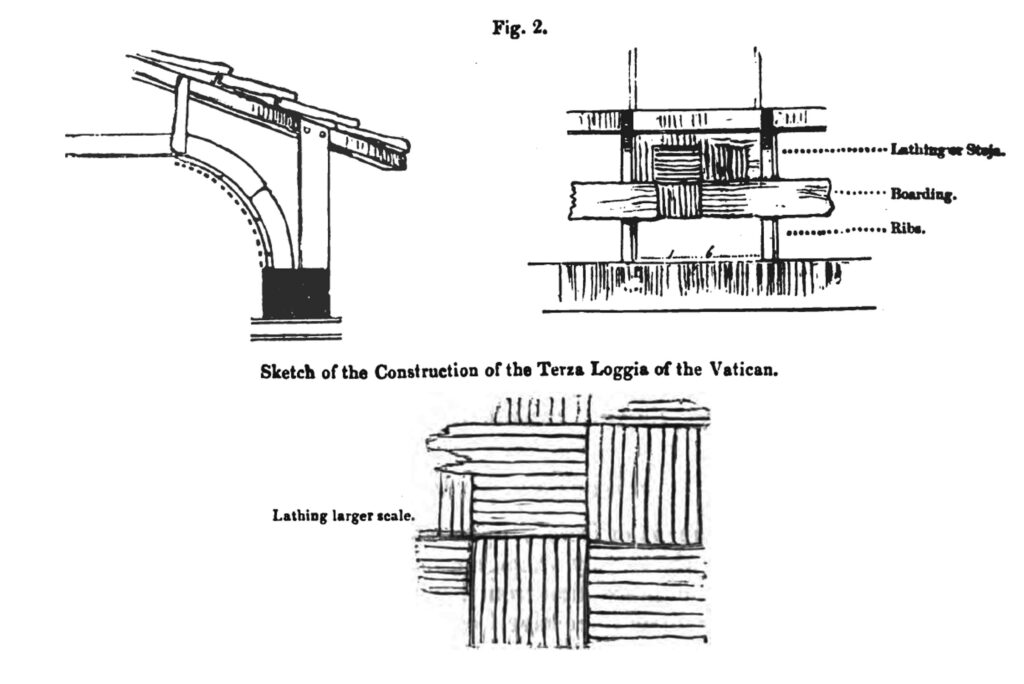
The ceiling frescos in the upper Loggia of the Vatican by Giovanni da Udine‡ are upon stoja or lath: the wooden framing to which the lath is attached is executed with a rudeness that would seem almost incredible, and these works have suffered severely from the original defective carpentry and from neglect and damp. (See fig. 2.)
‡ These have just been restored, under the direction of the Cavaliere Agricola.
At Florence, in the Palazzo Vecchio, there is a chapel painted in fresco by Bronzino, and the paintings on the ceiling, which are on lath, are in fine preservation, as are all the ceiling frescos in the public gallery of the Uffizj, executed in like manner upon lath or stoja. In the Palazzo Ducale at Venice there are some important frescos by Tintoretto upon a lathed ceiling, which are well preserved; and at the Villa Mazer, near Biadine, there are a number of frescos by Paul Veronese on what may be termed lath, although the construction is peculiar.
The construction of these coved ceilings is careful; the ribs which form the arches are of inch deal nailed together, as centerings are commonly made, so as to form ribs of two inches in thickness; these are thirteen and a half inches deep, and are placed three feet apart: on the under surface are nailed laths of poplar three inches by one inch; these are fastened the broad way, and being kept a little apart an excellent key is given to the plaster. The lathing is plastered above as well as below; this is common also in all the framed ceilings which I saw in France, (those at Versailles may be quoted as examples.) The practice is an excellent precaution against injury to the works beneath from the accumulation of dust and dirt, as it is very easy to sweep and keep clean such places, and for the same reason it is advisable to plaster the upper surface of brick vaults, which was the practice of the Caracci, as exemplified in the Palazzo del Giardino at Parma.
From these various instances it appears that frescos may safely be executed upon lath.*
* I am not aware that there are, in any part of Italy, examples of frescos executed upon any other kind of wall or preparation than those which have been described. I was at one time informed that the Aurora of Guido was executed upon a copper trellis: this I have since ascertained to be a mistake; it is on brick; but it is said that nails were driven to give the plaster a better hold, and this accounts for the spots, apparently of rust, seen on various parts of the picture.
THE MORTAR.
It is not possible to make many observations on the mortar on which mural pictures of the period before referred to are executed, as, fortunately, there are not a great number which are in such a state of dilapidation as to permit a particular examination of them in this respect. The majority of these pictures are painted, as is well known, upon an intonaco composed of lime and sand. It is evident that there was a diversity of opinion with regard to the quantity of sand to lime to be used, and the same diversity of opinion exists amongst the modern frescanti. From such examination as it was possible to make, it appears certain that those frescos have stood best in which it is apparent that there is a considerable proportion of sand in the lime; and I am disposed partly to attribute the bad state of the frescos by Correggio in the Duomo of Parma to his having used what is called a rich intonaco (that is, with a small proportion of sand), and the faintness of the colours is perhaps to be attributed to the same cause.
A number of mural paintings are executed upon an intonaco formed of lime and marble dust; these however are not frescos but distemper pictures; that is, pictures which, although in many instances commenced in fresco, yet were finished in distemper. Pictures of this description are also found upon intonacos of lime and sand; and if at first the practice may have arisen from necessity, it appears to have been continued afterwards from choice, even after complete works in pure fresco had been executed.
The Signor Marini of Florence, an experienced fresco-painter, is of opinion that the pictures by Avanzi, in the chapel of S. Giorgio at Padua, are frescos. This artist flourished in 1370.* The mural works of Fra Beato Angelico and of Gozzoli are certainly commenced in fresco and finished in distemper. That they were commenced in fresco is proved by the existence of joinings in the plaster at certain intervals; but that they were not finished in the same manner is quite evident, for these joinings are at such a distance from each other that we must suppose the artist elaborately finishing several figures the size of life, or nearly so, in one day, which is manifestly impossible. This subject may be further considered in treating of distemper-painting.
* It is also the opinion at Florence that the still earlier pictures by Spinello Aretino in S. Miniato are frescos.
There is nothing to be learnt apparently from old Italian plastering. In point of execution, it is surprising that such careless work could ever satisfy the artists. The Venetians have shown themselves in many instances clumsy plasterers beyond all others; the works of Pordenone especially exhibit the rudest workmanship, the surface being very uneven, and the joinings of the intonaco which mark the different days’ work being very carelessly executed: such is also the case in the frescos of Titian.
The Germans carefully teach the propriety of making all cuttings and joinings in the plaster at outlines, where it is possible to do so; but some of the old masters paid little attention to this rule. Andrea del Sarto frequently makes joinings at some distance from the outline of a figure, following at the same time no other outline; and this he has evidently done to enable him to paint in a little of the background at the same time with the figure, and whilst it was wet. Gaudenzio Ferrari has adopted in some cases the same practice. At times we find in the works of the above and of other artists, joinings carried across limbs and other parts of pictures in a very awkward way, the result of carelessness and want of thought, and the effect is disagreeable. With the exceptions just mentioned, the rule of cutting at the outlines is supported by the practice of all schools.
The carelessness of the Venetian artists and plasterers has been adverted to; the Florentine practice is better, but still far from presenting, in many of the early examples, sufficient attention to the preparation of the surface. If the wall was even, the plaster was made even, but if the wall was altogether the reverse, the plaster was allowed to be so also, and it is only in the works of later masters that we find this workmanship so attended to as to secure an even surface: the frescos of Allori in S. Lorenzo and in the Palazzo Vecchio are models in this respect. It was the practice of Allori to make his cuttings at a very acute angle with the wall, which plan is however, with much reason, objected to in modern practice.† In Rome, it has been already noted, that the frescos by Raphael in the Stanze of the Vatican are, unfortunately, specimens of bad plastering; those by the same immortal artist in the Farnesina are much better in this respect.
† It brings the lime or intonaco of the next day to so sharp an edge that it becomes difficult to spread it, and it is apt to dry too fast. The Germans cut at a much less acute angle, and the Florentines make the cut perpendicular to the wall.
The Cavaliere Agricola obligingly showed me some pieces of plaster from the ceiling of the third Loggia, painted by Giovanni da Udine, which, from their damaged condition, it had been impossible to retain in their places in making the repairs. These specimens exhibited three coats of plaster, differently prepared; the first (that next the lath) was of lime and coarse sand, and was one quarter of an inch thick; the next, of the same thickness, was of lime and pozzolana; and the last, or intonaco, was of lime and marble dust, by no means very finely pulverized.
This corresponds with the arrangement in ancient examples, from which it is evidently imitated. In the Baths of Titus examples will be found of—first lime and coarse sand, one half inch thick; then lime and pozzolana, of one inch in thickness, in which, however, there is an admixture of sand and pounded brick; the last and upper coat is of lime and pounded marble. It will be found that this, as regards the two last coats, is the identical preparation which is so commonly used in Italy for floors under the name of Venetian pavement, except that in the latter the fragments of brick in the substratum and the fragments of marble in the superstratum are much larger.
It is also quite plain, from the size of the fragments of marble in the specimens of ancient plaster, both in the Baths of Titus and at Pompeii, that the wall could not possibly be brought to a smooth surface either with the trowel or float; it must have been allowed to dry, and was then polished. It follows that in walls of this description the red, yellow, and other tints with which it was painted must have been subsequently applied, and had nothing of the nature of fresco, an art which, however, is apparently exemplified in ancient examples, for instance, in the Nozze Aldobrandini.
It may be generally stated, without adducing other examples of this period, that where the plastering is uneven, the ruin of the fresco, or its serious injury, is the result, whilst those frescos which have smooth and even surfaces will be found to be generally in good condition; and the most perfect specimens in point of workmanship and preservation are the frescos of the Caracci and of their scholars. These, in the majority of instances, are quite perfect, and may be quoted as triumphant specimens of the durability of this mode of painting.
THE EXECUTION OF THE PICTURE.
From the consideration of the masonry and plastering, I proceed to that of the execution of the picture; and first of the outline. The history of this process, as observable in the works of Italian artists, is of great interest. We find that whilst several mechanical modes of outlining (fully described in the First Report) were adopted for fresco, each artist used these means in his own peculiar way, little influenced apparently by any received rule; and as every artist commonly adheres to his own method, the execution of the outline may assist in deciding on the authorship of a work of art.
The practice of indenting the plaster with a point or stylus is very ancient, and we find that the figures painted in Etruscan tombs were thus outlined, that is, the point was used to mark the external outline of the figure only. It was employed by the early masters at the revival of art in Italy precisely in the same way in outlining their works in distemper on panel; thus Giotto drew, and his followers; and we find the same practice followed in the Sienese school, with a singular exception, which is, that the figure of the Madonna is entirely marked in with the stylus, that is, not merely the external outline, but the outlines of folds in the drapery are drawn in in the same manner; and a notice of this practice, confined to the school of Siena, is useful, as it establishes a clear distinction between the early pictures of that school and those of the contemporary Florentine masters.*
* I had an opportunity of making use of this observation in Rome in the case of disputed pictures, and it excited some attention and debate, both amongst distinguished artists and amateurs.
At a later period of tempera-painting (referring at present to easel pictures) the point was used in every part of the picture, as is exemplified in the works on panel of Fra Beato Angelico. It then came to be used, when oil was introduced, in the backgrounds only, which proves that the grounds for oil-painting were of the same nature as those previously in use for painting in distemper,† that is, of whiting.‡
† The stylus was thus used by many of the great masters; by Perugino in his architectural backgrounds; by Fra Bartolomeo, Mariotto Albertinelli, and others.
‡ The Signor Pacetti of Florence, who has carefully studied this subject, says that the grounds on which old paintings, whether in distemper or oil, were executed, were formed of a fine whiting called “gesso da oro.” This is said to be a product of Tuscany, and is unquestionably much finer than any whiting used in other parts of Italy, or in this country. It was mixed with a weak size made from parchment shavings, and could be drawn upon with a point with the utmost facility. The fact that these pictures were so drawn proves the softness of the ground.
It is very remarkable that whilst the point was used in distemper-pictures on panel, it rarely was in those of the same period on walls. It is never found in mural paintings by Cimabue, Giotto, Orgagna, or Benozzo Gozzoli, but was employed by Fra Beato Angelico in the architectural backgrounds only of the paintings in the Chapel of Nicholas V. in the Vatican; in this case he may have pounced in his outline with a cartoon, and then have ruled in the lines of his architecture; but as these lines are carelessly drawn down through the figures, an objection may be started to this theory, as the pounced outline of the figure would easily show where to stop. In Masaccio’s frescos in the Carmine the lines of the architecture are put in with the point, whilst the figures are not. It is very difficult to suppose that after the background was thus outlined the figures were drawn in with the brush only. It is true the head of Masaccio in fresco, which exists among the portraits in the Florence gallery, is merely drawn in with the brush; but this does not prove that the outlines of entire pictures containing many figures were so executed.
If cartoons were used in these earlier times, what could be the object of the curious practice of outlining in a rough and free manner on the last coat of plaster laid on previous to the intonaco itself? This is exemplified in all the frescos by Benozzo Gozzoli in the Campo Santo at Pisa:* wherever the intonaco has fallen down, the outline of the composition is seen marked in with red; and I was informed by Mr. Gibson, R.A., that in Sta. Croce in Florence there are examples in which not merely the outline, but also the colours are sketched in.
* Confirmed by Cennini’s description (see Trattato della Pittura, pp. 59, 60).
It has been supposed by some that these outlines were intended as a guide to the plasterer in spreading the intonaco, but in no case do the joinings in the plaster coincide with them. If we suppose that the composition was thus sketched in to enable the artist to judge of the proper proportions and positions of the figures, what then was the use of his cartoon in this respect? it would have been more easy to place it against the wall, as is now frequently done.†
† In the passage before quoted Cennini does not speak of any cartoon.
It is not easy to explain some of these facts, nor does the question much affect modern practice, but the subject is not without interest as connected with the early history and practice of art. The solution that the figures were freely and readily drawn in with the brush after the architecture had been drawn in with a ruler and point, it is not easy to accept; it implies a certainty and readiness in drawing which it is hardly possible to conceive; and yet this readiness seems asserted in the O of Giotto, who, on the occasion when he drew it, seemed desirous of exemplifying the perfection with which he could outline with the hair pencil; and the practice is exemplified on a small scale, by Andrea del Sarto, by whom there exists in the Academy at Florence a small fresco, the architecture of which is ruled in with a point, and the figures are certainly put in with the brush only; whilst the habit of making alterations in the outlines of his figures in larger compositions does not say much for the careful preparation of cartoons on the part of this artist.
It is very easy to determine by examination whether the point has been used with or without the intervention of a cartoon; in the first case the line is smooth, in the last sharp, and having a ragged edge.
Luca Signorelli seems to have been the first artist, or amongst the first, who used the cartoon and point in the manner followed and recommended by the Germans, but it will appear that this mode, however convenient, may in some cases be objectionable.
Another mode of outlining, that is by pouncing, was extensively adopted; this method, as well as the last-mentioned, of course implies the preparation of a large cartoon; and there was still another mode, or rather union of the modes above alluded to, viz. the outline was first pounced and then, the cartoon being removed, the forms were retraced with the stylus; this is the practice of the modern Italians, and although imposing names may be quoted in support of it, an uncertain and feeble outline is the result, and besides, in sudden turns it breaks out bits of the plaster, leaving unsightly holes in the picture.
A few instances may now be given of the different modes of marking the outline adopted by different masters. Luca Signorelli carefully marked in every necessary outline. Andrea del Sarto also used the point. Pinturicchio used it in his works at Siena and Spello. Although the absence of the use of this instrument is no proof that mural pictures are not fresco, its use is a certain proof that they must be so, showing that the lime was wet when the outline was put in, as any attempt to draw with a point on dry lime, would merely make a series of ruts with broken edges. The fact that Pinturicchio used the stylus at Siena proves beyond a doubt that, however much these pictures may be finished in distemper, they were begun in fresco.
The practice of Luini, may be mentioned as showing his facility in fresco-painting. In his faces the features are merely indicated by straight lines. On such careless outlines he painted female heads, the beauty of which never has been excelled.
Razzi the Sienese, of a still more impatient spirit, dashed in a few lines on the wall indicating the places of his figures rather than outlining them. He trusted to his facility with the brush, and is often very incorrect in his drawing; still the exquisitely beautiful female faces painted by him in S. Domenico, at Siena, are entirely produced by the brush, the outline previously laid in with the point being out of all proportion; thus the point of the nose and mouth of the St. Catherine, as outlined, are fully half an inch below the same features as finished in the painting.
The Venetian masters were by no means careful. Titian seems to have taken little pains in preparing the outline in his fresco pictures, which he seems hardly to have painted con amore, although in many respects they bear the impress of his genius. Pordenone used the point, and in some places where he appears to have changed his mind, he has taken the first thing that came to hand to make an outline, – perhaps the end of his mahl-stick, or the point of his dagger, thus breaking out lumps of plaster and producing irregularities in the surface which he never seems to have thought it worth while to have mended again.
Innocenza da Imola offers in his practice a striking contrast to that of the artists mentioned, he puts in every hair and wrinkle with the point, before beginning to paint.
It might be supposed that the spirit of Buonarotti may have shown itself in the vigorous and impatient marking of his outline, but such is not the case; he adopted the slower process of pouncing. There are no marks of the stylus in the Last Judgment. The remarkable distemper picture attributed to him, which hangs in the Tribune at Florence, is drawn in with the point; the Fates in the Pitti are not, neither is it seen in any frescos of his which I could closely examine.
Pietro Perugino pounced all his outlines, and so did his great pupil Raphael; but his pupils again followed each his own fancy in this respect. The following facts as to the frescos in the Stanze, may be interesting, and when taken in conjunction with other differences in the colour and mode of painting, may not be without value in considering these pictures with reference to the different hands employed in painting them. The stylus is nowhere used in the Dispute of the Sacrament, nor in the School of Athens, except in the drapery of Hippias, where the artist has made an alteration in the folds. In the Parnassus there is no use of the stylus, save in the robes of Homer and Tasso, probably therefore painted by a pupil who followed his own system of outline. In the Heliodorus, Attila, Mass of Bolsena, and Peter delivered from Prison, the point is not used, except in putting in the moon in the last picture. The Incendio del Borgo has first been pounced, and then outlined with a very sharp point on the wet plaster; the picture of the Oath of Leo III., is outlined in the same way, and so carelessly that the plaster is broken out in parts; these two pictures are in this respect a striking contrast to the others. Giulio Romano did not use the point in his Battle of Constantine with Maxentius.
Raphael did not use the point in his fine works in the Farnesina, and the advantage is obvious; those beautiful creations would have been injured by its use, for whilst its convenience makes it very proper to use it in works removed to a considerable distance from the spectator, it never should be seen in those which are nearer to the eye, especially if the light comes from the side.
In the Loggia the outlines of the ornaments bounded by straight lines are put in with the point and ruler, without the intervention of a cartoon; all other lines are apparently pounced, but on minute examination I found that they were pricked on the plaster. It is not easy to understand why so tedious a process was adopted.*
* A drawing to be pounced must be first pricked: the artist having perhaps to use the same outline again, and being in haste to transfer it to the plaster for the first time, may have caused it to be pricked against the wall, thus making his assistant perform two operations at once.
The Caracci and their pupils sometimes used the stylus, but in the great majority of the works left by them in all parts of Italy they preferred the spolvero or pouncing bag.
PAINTING.
In studying the art of fresco-painting, it is necessary to consult the works of the old masters for examples of execution. In everything that is merely mechanical, we may profitably study the proceedings of the modern Germans; every process may be learnt from their practice, without visiting Italy, the graceful use of the brush excepted. Amongst the works of the present Italian fresco-painters, there is perhaps no example which it would be desirable to follow. The execution of these artists is to the last degree mannered and heavy, and however satisfactory may have been the progress of the French in other modes of painting, they have entirely failed in the few attempts which they have made in fresco.
Avoiding the errors into which we may conceive that our continental brethren have fallen in the actual painting of their frescos, we must look to the works of the old masters as examples; in these we shall find painting in fresco, in as many styles, and exhibiting as much diversity of touch and handling, as may be observed in the works of the same artists in oil. There is the same liberty of thought in the treatment of both methods, and genius exhibits its powers with as endless a diversity in the one art as in the other.
We find in the frescos of the old masters every quality of execution that has a name in oil-painting, although those qualities are necessarily exemplified in different degrees; we have transparency, opacity, richness; we have thin and thick painting, nay loading, and that to an extent that cannot be contemplated in oil. We have the calm transparent elegant painting of the Florentines and Romans, the rich variety of the Venetians, and there are cases in which the well-nourished brush of Rembrandt seems represented in the works of the fresco-painters of old Italian times.
The distemper paintings of the elder masters have already been alluded to; it was their practice in laying in the preparatory tints in fresco to make some of these totally different from the colour to be used in finishing in distemper: thus, a dark red colour was almost invariably laid in as a preparation for blue, and this practice was generally adhered to with very few exceptions till after the time of Raphael.*
* Several Italian artists mentioned to me their opinion that a coat of terra vert was laid in at times as a preparation for blue; and as in many places I saw this green colour, I at first adopted the opinion, but on subsequent observation I ascertained beyond doubt that the green was in reality a blue which had changed.
In the works of Giotto, in the Campo Santo, at Pisa, the plaster seems to have been painted black in the first instance. Time did not permit a satisfactory examination of these works, but there is an example of the use of black as a preparation for blue in the Farnesina, where Daniele da Volterra† in his frescos on a ceiling in that edifice has first laid in a coat of black in fresco, and then a coat of blue in distemper.
† For whom the criticism of Michael Angelo’s drawing of a large head, still to be seen on the wall, was much more probably and appropriately intended than for Raphael.
In some pictures, as for instance in those by Andrea Mantegna in the Eremitani at Padua, the blue of the skies has either partially changed or entirely faded, whilst that of the draperies is comparatively well preserved, it is thus evident that from motives of economy different blues were used in different portions of pictures. There are many other examples of this in other parts of Italy.
The Cardinal Bonaventura, in the fresco called the Dispute of the Sacrament, by Raphael, is represented in a purplish-black robe which has been painted over red; this is an instance of the adoption of an indirect process with reference to another colour besides blue. It may be observed, that the cardinal was a Franciscan, an order which is distinguished by a brown dress; and, as it is not brown in the picture, this may perhaps be an instance of a change of colour: but one object of this mode of painting seems to have been the security of the colours against change, while another may have been, the attainment of more harmony in the tone. In the picture just mentioned, Raphael has followed precept in painting the blues in distemper over red, and these have stood perfectly. In the School of Athens, on the contrary, he has painted in the blues in fresco, and they have perished or nearly so, as they have in most instances in every part of Italy where blue has been thus used; both in pictures of this and of previous times. In the great works which Raphael subsequently painted in the Stanze he returned to the old practice of painting the blues above red, probably dissatisfied with the crudeness which was the result of using them on the wet plaster. The blue that has thus been generally used seems to have been of a vegetable nature, as in many instances it has changed to a brilliant green. It may be urged that the use of ultramarine or cobalt may obviate all necessity for such preparations, and secure the pictures against change; but whilst the former is by far too expensive a colour, the latter is crude and harsh in fresco. It seems to have been the blue which was used by the Caracci, and in their pictures, as in those of Guido, it will be found to be frequently out of harmony with the other colours; either these have in some degree faded, the blue remaining the same, or the blue has increased in intensity. Domenichino used distemper extensively in his works; but in those of Guercino will be found a triumphant solution of the difficulty; his blues are put in in fresco, and yet are in fine harmony with the other tones, they have generally a warm purple hue, and may be either smalt, or cobalt tempered with a red, such as colcothar of vitriol. This is strongly exemplified in the Zampieri Palace at Bologna, where the harmony apparent in a fresco of Guercino is an agreeable relief, after the crudity which offends in those of his masters in other rooms of the same palace: a comparison between the Aurora of Guido in the Rospigliosi at Rome (all the blues in which are not retouched) and that by Guercino in the Ludovisi, further corroborates the above observations.
As has frequently been stated in the previous Report, it was the practice to retouch when the fresco was dry, more especially in the shadows. In some cases it is now easy to detect this retouching; it will generally be found to be proportionably somewhat darker than the painting around; and whilst in many frescos a remarkable polish or gloss may be observed even in situations where that effect could not be produced by rubbing, the retouched parts are invariably dim; this is exemplified in the Evangelists by Domenichino in the church of S. Andrea della Valle at Rome: these are historically known to have been retouched; and in viewing them from particular spots, their surfaces are seen to shine as if varnished, whilst some parts, which it may reasonably be inferred are retouches, such as darks under the arms and in the deep folds of the drapery are quite flat and dim.*
* It also appears from one instance at least, that a retouch in distemper does not change so much from the action of damp as the fresco itself. The pictures by Professor Schnorr, in the Villa Massimi in Rome, are much injured by the action of damp from the soil, and have become light and cloudy. The retouches (for in these early efforts the Professor did retouch) have all become visible, and appear as dark spots. The vehicle employed, as I learned from the artist himself, was yolk of egg and vinegar.
There are portions in Raphael’s pictures which present the appearance just described; in the School of Athens there are a few distemper touches evidently by the master’s own hand, which have darkened: for instance, in one head he has had recourse to distemper to represent the external locks of hair. This seems to indicate a difficulty in fresco which at first sight appears formidable. In a picture by Gaudenzio Ferrari, at Milan, a female head with long flowing locks is represented, and the joining is made next the locks, and has a very bad effect; the difficulty is successfully overcome by the German artists without having recourse to distemper, and without placing the joining so as to injure the appearance of the picture. This may best be exemplified by a sketch: the flying tresses are painted in on the back-ground on one day, and the head is put in the next day; the joining is indicated by the dotted line in the figure. The foliage of trees is managed in the same way. It would be vain to think of cutting round the outline of foliage; the outer leaves and thin projecting branches are executed on the same day with the back-ground, and the cutting is kept quite within these. (See figs. 3, 4, and 5.)
To return to the frescos of Raphael. The Heliodorus, Miracle of Bolsena, Attila, and Deliverance of Peter seem to be pure frescos, with certain exceptions already alluded to. In the first of these pictures there is a portion which exhibits a remarkable contrast to all the rest. The papal chair-bearers, known to be portraits of the artist’s friends, are painted rather in the style of Pordenone than of Raphael; the lights are much loaded and have apparently been glazed, and, as extensive retouching in distemper has evidently been had recourse to, these retouches have become very dark.
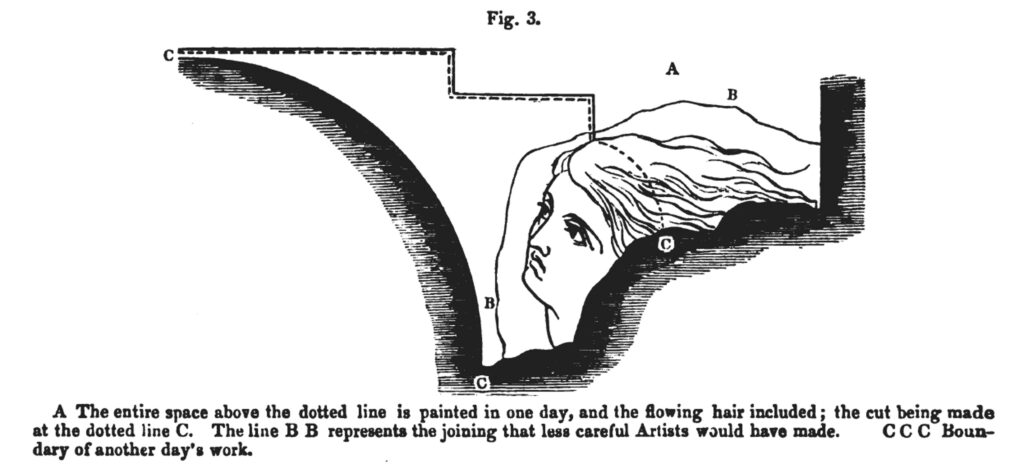
A. The entire space above the dotted line is painted in one day, and the flowing hair included; the cut being made at the dotted line C. The line B B represents the joining that less careful Artists would have made. C C C Boundary of another day’s work.
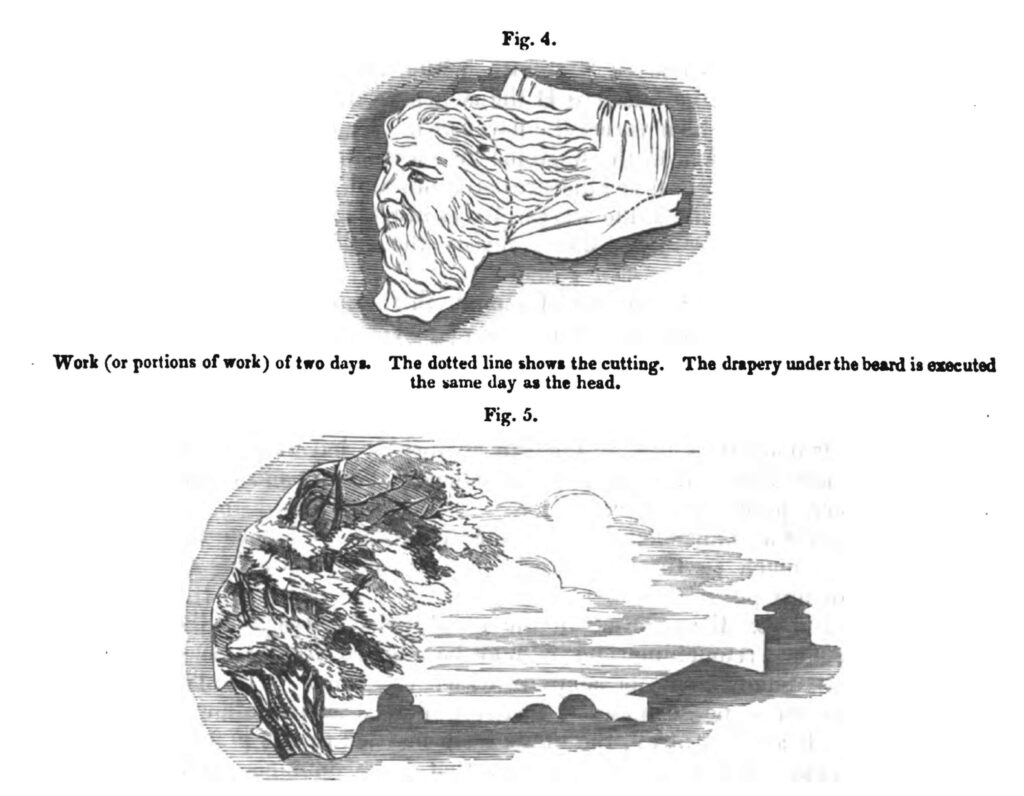
The ostentatious freedom with which these figures are painted contrasts disadvantageously with the calm dignified execution of Raphael. With regard to the duration of this part of the picture as compared with the other portions, apparently in pure fresco, that which is so much retouched has certainly stood as well as the rest, with the exception that parts have become dark.
M. Orsel, a distinguished French artist, who has attentively examined the fresco of the Last Judgment by Michael Angelo, says that it is much retouched in distemper, and without doubt by the great artist’s own hand; as this distemper has darkened considerably, the present tone of the picture is accounted for, without having recourse to the supposition that the smoke of candles has been the sole cause. M. Orsel says that the retouching of Michael Angelo’s great work is all effected by hatching: this fact necessarily leads us to infer that retouching was carried to a great extent in old frescos, but, as will be shown, hatching is also much practised in the actual process of fresco-painting, and it is consequently difficult to form a very correct judgment in every case as to what may or may not be retouching. Many important pictures exhibit much hatching, which is probably retouching. The Madonna del Sacco of Andrea del Sarto may be instanced; if the very regular hatching over this picture be retouching, it has stood perfectly well. It is not probable that Daniele da Volterra, who added certain draperies in Michael Angelo’s fresco, ventured to retouch the figures.
The story of Franciabigio’s wrath at the premature exhibition of his fresco in the court of the SS. Annunziata at Florence, may be instanced as supporting the prevalence of the practice under discussion, amongst the old masters: the picture was not finished in the artist’s estimation, yet as fresco it would be pronounced to be so: all the intonaco is laid and painted upon, but as he esteemed the work incomplete, it is quite plain that he meant to retouch it in distemper.
From these and other examples we find that although as art advanced, the extensive use of distemper, at first prevalent, was given up, and that pictures were chiefly executed in fresco, still the practice was never entirely abandoned; and till art was revived by the Caracci, it may justly be doubted whether there is one mural picture in existence that is entirely completed in fresco.
Indeed after the adoption of fresco-painting, an apparent love of the older practice induced artists to return to it. Pinturicchio adopted it; his pictures at Siena are unquestionably much painted upon in distemper.* Those at Spello seem to be executed much in the same way. The pavement in one of these pictures, for instance, is laid in flat with white, in fresco; when this dried the artist evidently outlined the divisions of the stones over it, and he then laid on in distemper the colours which varied the pavement. In the pictures by the same artist in the church of Ara Cæli in Rome he has returned to the practice of the early masters; he has begun the pictures in fresco and then entirely painted them over in distemper: and in all the works of this artist, foregrounds and foreground plants, landscape back-grounds, and probably the skies, are executed altogether in distemper.
* M. Orsel, however, thinks that these have been retouched in wax, nor is the opinion wholly improbable; in a chapel in the Palazzo Vecchio at Florence there are frescos by Ridolfo Ghirlandaio which have been lately cleaned by Signor Marini, who informed me that they had been glazed with something “unctuous,” to use his own term.
In the church of S. Onofrio at Rome, there are specimens by Baldassar Peruzzi which are painted in the old way; and the fine work of Melozzo da Forlì, now transferred to canvass and placed in the Vatican, is another instance of the extensive use of distemper. This last picture is in excellent preservation. There seems to be no reason to doubt the durability of this kind of painting although other objections may be brought against it; but where egg has been the vehicle used, the colour, if loaded, has a tendency to scale off, while the pictures darken and become inky in tone.
The Genoese also abandoned true fresco-painting, and used distemper to a great extent, so much so that their works may be considered apart under the head of distemper-painting.
It is evident that the practice of the great masters supports the propriety of a certain amount of retouching, and it may be inferred from their works that no very bad results follow from its adoption within due limits. The Germans, however, maintain an opposite opinion, insisting that it is not allowable and quite unnecessary. If adopted at all, the limits seem marked by the practice of Raphael in his later works; but it may be observed that loose opinions upon this subject might lead to careless practice, and in this view of the case the severe injunctions of the German masters are of value.
TRANSPARENCY.
This important quality is perfectly attainable in fresco-painting; it is found in the works of the Roman and Florentine masters; amongst the latter, more especially in those of Andrea del Sarto; in those of the Lombards it is admirably maintained; and its excess is seen in those of the Venetians.
It is not easy to explain how transparency is to be attained in fresco; there is, perhaps, no quality in which our German brethren are more deficient; the brushes which they use are to an English eye small for the work, and the first tint laid on with these presents a streaky appearance, which perhaps could be obviated in some instances by the use of larger brushes, and a different mode of using them. It will be easily understood how this streaky appearance is produced: having first given one wipe of the brush full of colour, the artist follows it up with another, the colour sinking in instantly, and as he cannot lay the second wipe exactly to the edge of the first, the one overlaps the other in parts, and those parts are consequently twice as dark as the others which have got only one wipe, and so he proceeds laying a tint composed of light and dark streaks, but nevertheless transparent: this quality is lost in uniting the tint, for he continues to go over the surface till he obtains what he seeks, a quiet flat tone, which however generally proves a heavy one. Now, in the ancient examples, this union is obtained without sacrificing transparency. In a church near Conegliano there are some curious frescos by a Venetian painter, in which the excess of this quality is exhibited; they do not merit the name of works of art, and are very slightly executed; the colours seem laid in in one wash only, the plaster ground shining through; but these bad pictures prove that it is possible to lay in tints in a transparent and yet flat manner. Titian frequently makes use of the bare intonaco in particular places; thus in his fresco of The Healing of the Foot of the Boy &c., in the Capitolo of S. Antonio at Padua, the shadows are laid in with brown in a very transparent manner, and for the half-tint he has left the bare lime. It may be doubted whether this practice is to be recommended; it is never found in the frescos of the Florentines or Romans, and that great fresco-painter, Luini, obtains equal lightness and transparency without having recourse to it. Such a practice gives a work a sketchy character which is objectionable, especially in the principal figures. How the effect of transparency is to be mechanically obtained it remains for the artist to discover by practice.
A Milanese professor says that with a view to transparency it is necessary to lay in the first tints early in the morning, and then to leave the work and not to resume it for two hours. He further says that the lime, if it have any remains of an injurious caustic quality, exhausts its fury, to use his own words, on these first colours, and may be more safely painted on afterwards. It must be confessed that the frescos by Appiani, which he instanced as examples of the practice, are very far from exhibiting the quality of transparency. Other artists, however, hold the same opinion, and it is therefore proper to state it.
HATCHING.*
The prevalence of this practice amongst many of the old masters (for it is evidently not always the result of retouching) seems to prove that they also found a difficulty in getting flat tints; in some of the later masters it is a mere manner, but in earlier and better examples it may have been adopted in the hope of getting a flat tint without destroying transparency: whatever was the reason the practice was very general, and it is to be observed that the great masters did not cross in this hatching; the lines lie all in one way, and Signor Colombo of Rome, says that the tempera hatchings in Michael Angelo’s Last Judgment are thus laid on with great evenness and dexterity.
* This term of art means employing lines in shading somewhat in the manner of engravers, but more freely.
In the works of Raphael, the most perfect of fresco-painters, there is no hatching† anywhere, nor is there in those of Correggio. The hatching with which the Cupids of the last named painter in the Convent of S. Paolo, at Parma, are covered and destroyed, is manifestly the work of another hand; the lunettes underneath have fortunately escaped this profanation.
† The clumsy hatching visible in parts of the frescos in the Stanze is evidently to be attributed to Carlo Maratta.
SOLID PAINTING.
This is a quality that is easily attainable; it will be best understood by observing, that whilst the plasterer lays on a preparatory intonaco of lime and sand with the trowel, the artist lays on a finishing one of lime and colour with the brush, and he may employ it as thickly as he pleases. I observed in the works of Pordenone in Sta. Maria in Campagna, at Piacenza, that the lights were laid on with such a body of colour that before the lime had time to set, the artist’s sleeve, or mahl-stick, or something else in his way, has accidentally ploughed through his work, which he has not been able, or has not cared to mend.
Paul Veronese, in his frescos in the Villa Mazer, has charged his lights; and his imitators in their works, both in the above villa and in that of the Obizzi near Padua, have loaded so much that the lights stand up in lumps upon the wall. Such extravagancies, like the washing in of the shadows in the pictures near Conegliano before mentioned, are poor substitutes for a careful imitation of nature.
The lights must of necessity be thicker than the shadows, as there is more lime in the colours of the former than in those of the latter. The great masters laid in their colours without ostentatious handling; their works exhibit no tricks of manipulation; but it is surprising to observe the manner in which some artists seem to have worked their tints. Pordenone has already been alluded to, and Polidoro da Caravaggio produces an effect as if his brush had been full of macguilp, as may be seen in his frescos in Rome, viz. in S. Andrea on Monte Cavallo, and in the Farnesina.
It is necessary to mention these instances to prove the extraordinary dexterity that has been attained in painting in fresco, a dexterity however, which is not to be admired when it produces such effects, and which too often distinguishes the pencil of mediocrity.
GLAZING.
This process is frequently exemplified in the fresco-works of the old masters; its most successful application is seen in those of Razzi at Siena, where the celebrated picture called the “Cristo alla Colonna,” in the gallery of the Academy, is a particularly interesting example of its legitimate application in fresco, that is, of its use while the plaster is still moist; in this instance parts are made out by means of it, and much lightness and transparency are attained.
Pordenone invented or adopted some process which resembles that common in oil-painting; his works have evidently been glazed after the lime had been allowed to dry; the flesh in all his figures is richly glazed, – the transparent colour filling up the hollows arising from the peculiar loading already described as so remarkably exhibited in his frescos, if they can be called such. Polidoro da Caravaggio seems to have adopted some analogous method, but probably these are the only masters who can be quoted as having adopted a practice so foreign to fresco-painting. Perhaps the artist who painted the papal chair-bearers in the Heliodorus may be added to this brief list. The adoption of such a practice evidently arises from a misapprehension of the legitimate application of fresco-painting. It will be found that the Venetian painters generally had no clear idea of the true mode of employing this art: even Titian fell into the mistake of trying to produce effects of light and shadow and colours, like those which he had been in the habit of producing in his oil-pictures. The light and brilliant colouring of Paul Veronese enabled him to paint with more success in fresco than the generality of his Venetian brethren; but in his works it is evident that this is merely the result of his system, not any attempt at an application of the principles of colour suited to the peculiar art of fresco-painting, which he sometimes practised, and most successfully at the Villa Mazer. Palma Vecchio alone of the Venetian masters seems to have truly estimated the powers of fresco; there are two Saints by him in S. Liberale at Castelfranco, which have breadth and dignity.
Razzi has already been alluded to as an artist whose works most prominently exemplify legitimate glazing in fresco; it is not apparent in the works of any other master to the same extent.
TIME OCCUPIED BY THE ITALIAN MASTERS IN PAINTING FRESCOS.
It is not difficult, in examining some frescos, to ascertain how much time has been occupied in painting them. In some examples, the joinings by means of which this calculation can be made are distinctly visible; in others they are either so well executed, or are so concealed by the use of distemper, that it is very difficult to trace them.
It is evident that the old masters painted with great rapidity; large and important works, judging from the following examples, were executed in a month or six weeks.
The “Incendio del Borgo,” in the Stanze, seems to have been painted in about forty days; the group of the young man carrying his father has been executed in three days.
The exquisite group of the Graces, in the Farnesina, by Raphael, has been painted, at most, in five days. The Cupid and the head of the Grace, with her back to the spectator, have occupied one day; the back and part of the lower limb of the latter figure, another. In this day’s work the rest of the leg may have been included. There appears to be a joining across the knee; there was certainly one across the neck; both these joinings do not follow outlines, but are in parts of the figure which are in shadow. It is of course better, as has been already observed, to cut by outlines; but this is not always possible, especially in very large figures. The Germans prefer cutting across a broad light when circumstances compel the artist to make a joining where there is no outline.
The graceful composition called the Galatea, also in the Farnesina, has been entirely executed in eleven or twelve days; the head and body of the principal figure have been painted in one day. This subject will be further incidentally illustrated.
DURATION OF FRESCOS.
The circumstances which must be taken into consideration in judging of the duration of frescos have already been adverted to. It has been shown that where proper constructive principles have been attended to, and where the walls are of good and appropriate materials, the safety of the paintings is in a great measure secured, and it may be certainly proved that fresco is a very durable mode of painting, not surpassed in this respect by any other, if indeed equalled.
But independently of the most careful building, various causes may contribute to the deterioration or destruction of frescos, and as these have been very distinctly described in the First Report it is not necessary to say much on the subject further than to state a few facts.
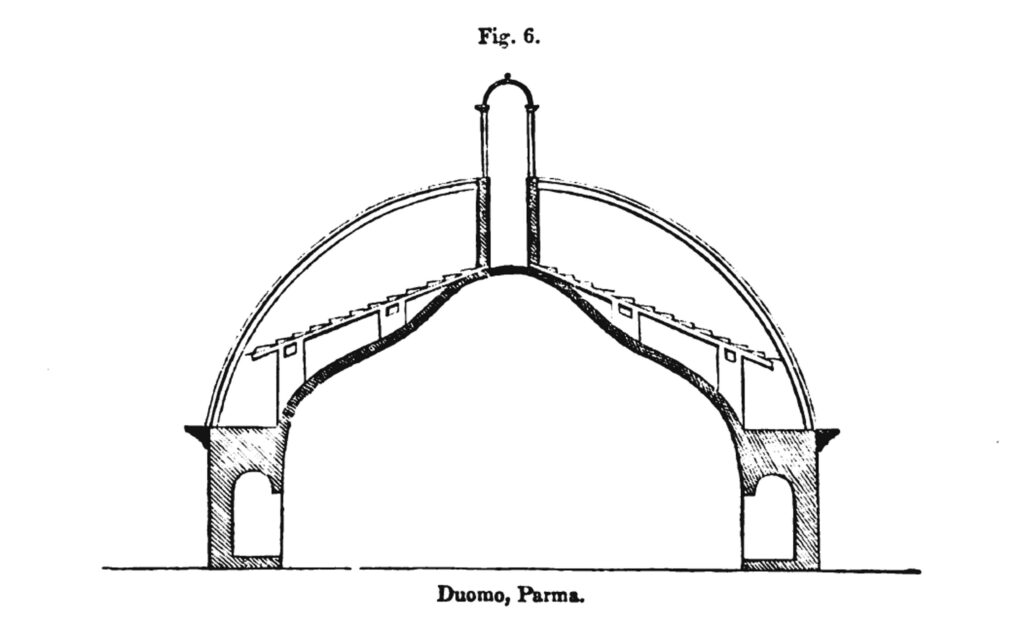
Damp is the greatest enemy of this kind of painting; it ascends through the walls from the soil, and descends from ill-constructed or dilapidated roofs. In Venice, where the houses actually stand in the water, the external plastering falls off entirely to a height of twenty feet; in Milan, Padua and elsewhere, I observed that paintings are obliterated on walls to a height of from seven to eight feet from the ground. The destruction of many fine works on roofs and on the upper part of walls is entirely to be attributed to culpable negligence, or to ignorance; this is painfully exemplified in the Duomo at Parma; the old insufficient roof over the dome still exists under the new leaded one which has been added to save the wrecks of Correggio’s works from final destruction; and the inadequate construction of the former is sufficiently apparent in the section (fig. 6). Many examples might be adduced of injury resulting to frescos from imperfect roofing, and the fact having been recognised, precautions have now been taken after irreparable injury has been done. The tiled roofs of Italy have everywhere been a constant source of injury to frescos, but in some few instances precautions of an extraordinary nature have been taken to make the roof water-tight. At the Villa Mazer flat tiles have been laid at right angles to the roof-timbers, the joints being filled with lime. These tiles represent the planking under slates in this country, and the ordinary roof tiles are put over them in the usual way; this makes an impenetrable but very heavy roof. The plan has lately been adopted in the Palazzo del Giardino at Parma, the frescos there by Annibale Caracci having suffered from damp. The Caracci have evidently been alive to the necessity of taking precautions against damp: the vault in the Farnese Palace in Rome, which is under an open loggia, is covered with lead; at the Palazzo del Giardino the upper surface of the vaults has been carefully plastered; but this has not sufficed.
Some frescos by Allori, in the Palazzo Vecchio at Florence, which are on a six-inch brick wall, have lately been destroyed by plastering the back of the wall. In the Library at Siena, the paintings on the vaults were ruined by some masons who mixed lime above them. All these facts prove the necessity of preventing, by every possible means, the passage of damp through the walls, and there is no difficulty whatever in effecting this.
External frescos may never be executed in this country, but their preservation in some parts of Italy may encourage their adoption in corridors and porticos. Paintings are found to be well preserved on external walls turned to a favourable weather quarter.* Thus, as at Genoa and Treviso, although frescos are nearly obliterated by the action of the weather on some walls, it is to be observed that wherever they are protected by the projection of a roof or cornice, they are well preserved. External damp or sea air has no bad effect. The obliteration of external frescos in Venice cannot be attributed to this, since those at Genoa are preserved; and those in the Campo Santo at Pisa, are doubtlessly destroyed by damp from the soil and roof. As has already been observed, that by Orgagna, in the same place, has not suffered at all from the action of the atmosphere.
* See the First Report, p. 15.
The paintings in the upper loggia of the Vatican have suffered severely, owing to the inefficient construction of the roof. Those beneath, from Raphael’s designs, have been much obliterated, partly by damp (the corridor above having been left open till lately), and partly from their having been painted on an intonaco of lime and marble dust; they have also suffered in some measure from violence and mischief. To this last cause, unfortunately, the destruction of many valuable works is to be attributed, as a number of the buildings which should have been consecrated by the works of genius have occasionally served as quarters for the rude soldiery of ruder times, or even for the galley-slave.
Many fine works have been irremediably injured by the populace; even those in churches have suffered in this way, and those in cloisters have also been much injured by wanton mischief. It is a mistake to suppose that the natives of Italy are exempt from this disposition, which is sufficiently proved by the injury inflicted on many precious monuments of art in that country.
Smoke has frequently been mentioned as a dangerous agent of destruction, but its effects can be removed. Thus, in the Palace at Modena there is a large hall, the ceiling of which is painted by Franceschini. The wood-work in the lower part of the hall was entirely burnt some years ago, and the frescoed ceiling was completely blackened by the smoke, but was afterwards cleaned with perfect success.
The frescos by Guercino, at Piacenza, have been injured in a peculiar manner; birds getting into the dome have flown against and scratched them.
It may be proper to mention the frescos of the Bolognese school in the Louvre at Paris, the climate of which resembles that of this country; with the exception of one, destroyed by the infiltration of water carelessly thrown on the floor above, these paintings are in a very good state.
DESCRIPTIONS OF PAINTINGS IN FRESCO BY DIFFERENT MASTERS.
IN further elucidation of the subject of this Report, a few descriptions of frescos, from notes made on the spot, are here added. These notes are given in the order in which they were written. No classification with reference to the age of the pictures was thought necessary; the notes were confined, as much as possible, to practical details.
TITIAN.
The St. Christopher, on the wall of a back staircase in the Ducal Palace at Venice, is very rich in colour, but there is no tone in it that has not been obtained by means of the usual fresco colours. This picture has been painted with great rapidity, apparently in two days, as there are traces of joining in one place only. The outline has first been carelessly marked in with the point, without any cartoon, and the artist has altered it considerably as he painted. In some places parts of the drapery have been put in without any outline having previously been made, and the background has been hastily rubbed in at the same time with the figure, and is very slight and careless. Titian has hatched over a great part of this picture in a free but somewhat clumsy manner. The intonaco, which is about 1/8 of an inch in thickness, has fallen off in some places, showing that it was spread on the brick wall without any previous plastering.
In the Capitolo di S. Antonio, at Padua, there are three frescos by Titian. The subject of the first is St. Anthony proving to a jealous husband his wife’s innocence. The effect of this picture is unsatisfactory; but on examination it appeared that the only pure parts are the heads of the lady and her female attendants, and some other more trifling portions: all the rest has been re-painted, apparently in oil. The female heads are very fine in expression; and with regard to the mode of painting, the lights are loaded, the shades quite transparent, and the whole mechanical treatment is that of oil-painting.
St. Anthony restoring a criminal at the intercession of his mother. This painting is in more perfect preservation; the landscape background only seems restored. Titian painted in fresco in a very sketchy manner, and as has been remarked, with great rapidity, this picture having occupied a few days only. The drawing is careless, especially that of the extremities; the draperies are painted in a very slight manner, and the general effect of the picture is not striking. These frescos look like ineffective works in oil. In these examples Titian has attained little beyond harmonious colour. Every part of these works is painted in a thin manner, the lights excepted. In the body of the youth he has availed himself of the colour of the intonaco in the half tints, the shadows being laid in with brown. Near this work there is another fresco by Titian, which, however, is in a very ruined state.
There are some frescos by this artist in the church of S. Rocco at Venice. Those behind the altar are remarkable for a washy slovenly appearance; the plaster is quite uneven, and the joinings are clumsily managed. Nothing can exceed the indifference which the Venetian artists have shown to such matters of practical detail. On one side of the nave there is a picture in oil, to which Pordenone has made an addition on each side in fresco. He has succeeded perfectly in so harmonizing the parts in fresco with the work in oil, that it is difficult to detect the difference; but on examination it may be observed that lakes are used in the oil-painting, whilst the reds in the fresco portions are earths only.
The most interesting pictures in Piacenza are those by Pordenone in Sta. Maria in Campagna. On entering the church, immediately on the right hand there is a fresco representing one of the fathers of the church with infant angels around him. This picture would have been in perfect preservation had it not been wantonly injured, much of the lower part having been scraped off the wall. The flesh of the infant angels is painted with a luminous tint, and with a cool pearly tone in the shadows, and has been subsequently finished with a warm glazing; the result in this particular picture is a clearness, brilliancy, and pearly quality, which probably never has been excelled by any master of any school. The taste displayed in the drawing is like that of Correggio, but with more correctness; all the heads are excellent, and that of the father and the cherub to his right, are particularly remarkable. Fine in design, and exquisite in colour, this fresco may be ranked amongst the first productions of painting.
The great dome of the church, the spandrils and soffits of the arches underneath, two smaller domes of side chapels, various pilasters, lunettes, and three great wall-spaces are painted by the same masterly hand. In these works, force of colour is carried as far as seems possible; and in that in the chapel of St. Catherine the success with which the aerial perspective is maintained, whilst bright and hot colours are used in the distance, is surprising. The forms are noble and finely designed, and some of the female figures are strikingly graceful and beautiful.
The effect of colour is, in a great measure, produced by Pordenone’s remarkable glazing process, whatever that was. There is a full body of colour underneath, in which the marks of the brush are seen, leaving deep furrows: over all, a quantity of warm glazing is laid on most unsparingly; it may be seen filling the markings of the brush; and the articulations of the fingers and the nails are made out with it in hands which are drawn with the vigour of a Buonarotti.
In some parts of the draperies this glazing is partially removed, and, if I was not misled by the present state of the pictures, these parts have been painted flat with the local tint, the shadows being merely indicated with a somewhat darker shade of the same hue, and the whole has then been completed with powerful glazing.
This mode of painting stands quite as well as fresco; but it is to be remarked that these pictures, with the exception of the first mentioned, in which there happens to be much naked flesh, have not the luminous quality of fresco, and cannot be viewed as successful applications of painting to architecture.
PAUL VERONESE.
The frescos by this artist in the church of St. Sebastian in Venice are entirely obliterated by damp, and those in the Ducal palace have faded so as to be nearly invisible: those at Castelfranco have also faded greatly, and Paul Veronese is the only artist whose frescos have sometimes decayed in so remarkable a manner; but in the Villa Mazer, near Biadine, he has left works which excel in some respects his paintings in oil, (or apparently in oil, for it may be suspected that many, if not most of his pictures, are in distemper,) and place him in a high position as a fresco painter. The Villa Mazer was built from designs by Palladio, and was once the habitation and property of Mannini, the last of the Venetian doges; it is now the property of Signor Colferrai. In this villa there are eight rooms painted by Paul Veronese in fresco. These paintings are in perfect preservation, one only being a little injured by damp, which has accidentally penetrated through a broken tile. The greatest care has been taken in the construction of the arched ceilings, which are composed of centerings 13½ inches deep by 2 inches, in two thicknesses, to the under side of which are nailed laths of poplar 3 inches by 1 inch, and on these the plaster is laid, (see fig. 7,) the interstices between giving an excellent key to the lime; the upper side is also carefully plastered, and the whole has a boarded flooring over, a precaution evidently against the risk of people passing over the ceilings; the roof is carefully constructed with tiles laid under the usual roof tiles and at right angles to the timbers as before described.
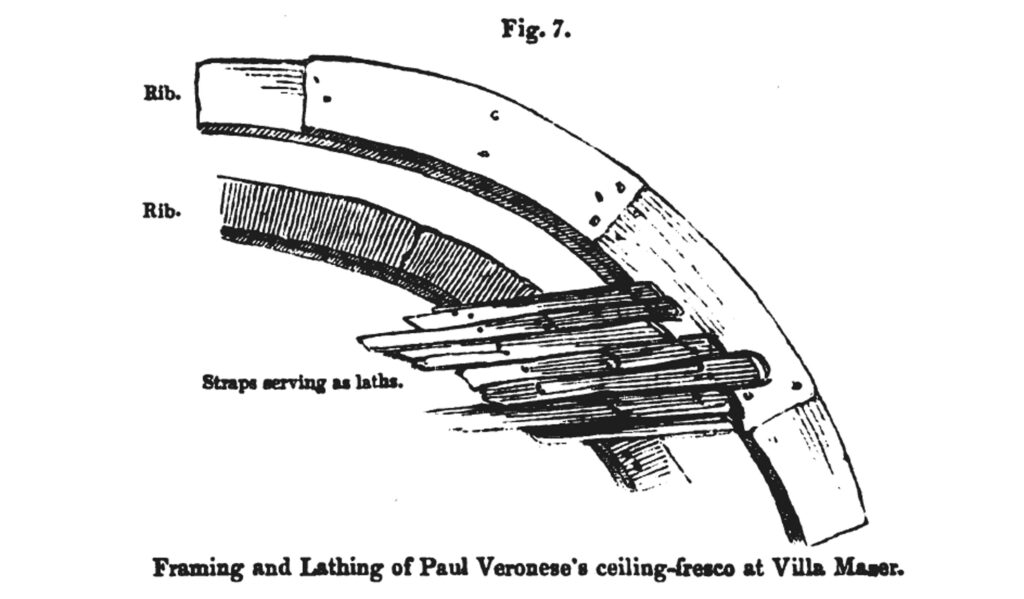
The qualities in colour, which are common in Paul Veronese’s oil pictures, are exhibited in these frescos, and in some parts with even superior brilliancy. The works are chiefly distinguished by great clearness of effect, but are too slightly executed; the draperies may be said to be washed in rather than painted; still there is great mastery in the manipulation. The heads are very carefully executed, and parts of the flesh may be said to be perfectly painted; the extremities, as usual with this artist, are indifferently treated. There is much loading in the lights and a little hatching in parts, but freely and effectively introduced where he thought it might have an advantageous effect, unlike other frescos by Pellegrini in the same building, which are disagreeably hatched all over, as if he could not manage his materials.
In the arrangement of these frescos much bad taste has been exhibited by the artist: he has not at all considered architectural propriety of design, but in other respects these remarkable works are worthy of attentive study.
The usual fresco colours have been used with one exception, viz. a bright yellow, like crome, which has turned quite black in the high lights, although it has not changed where there is less lime in it. The blue has come off entirely in some parts and has evidently been laid on when the figures were finished and the lime too dry, so that, not being incorporated, it has come off in powder; in other parts, where the artist has evidently been obliged to use it first, it is perfectly preserved.
There are some remarkable landscapes by Paul Veronese in fresco in this villa, in which much ability is shown: in these and in the backgrounds of the other paintings the most poetical effects are produced; a play of light and shadow, finely toned clouds, rainbows, and rays of light are introduced with successful mastery, exhibiting, in a varied and remarkable degree, the powers of fresco.
GIROLAMO DA’ LIBRI.
At Verona there is a fine fresco by this artist on the wall of a house. It appears that his subject required much red in the dresses of the figures, and in painting the Madonna in the centre, he has departed from prescriptive custom and has made her garment yellow instead of red; her mantle seems to be black, but may originally have been a deep blue.
TINTORETTO.
There are some frescos on the ceiling of the “Sala delle Quattro Porte,” in the Ducal Palace at Venice, by this artist: they are remarkable for richness and depth of colour, and are well preserved.
LUINI.
In the Brera, at Milan, there are a number of frescos by different Lombard masters, some on the walls, which have been sawn from their places, and others which have been transferred to panel. The most important of these frescos are those by Luini, which are of a very fine quality. They are, generally speaking, painted thinly and with great freedom; but although there is evidence of his having painted with great rapidity, he displays great mastery in drawing. There is much less labour than in his oil pictures, but still to these last the frescos bear a general resemblance. The backgrounds are mostly light, although in some paintings he has relieved the figures upon dark grounds; but there is no attempt to gain depth, which was evidently the object of the Venetian painters: on the contrary, Luini has gone into the opposite extreme in several of his works; in others, however, there is much power, attained perhaps on a better principle than in the frescos of Titian and others of the Venetian school; there is no confusion of tones, but that distinctness, which is essential to the effect of frescos, is preserved. The execution is light and graceful, quite unlike that of the present German school, which is comparatively laboured and heavy.
It is evident that Luini painted in fresco with great rapidity, executing more indeed than an entire figure, the size of life, in one day, and he certainly did not prepare cartoons, at least not for his small works. The painting may be compared to that of Rubens; it is juicy, transparent, and clear. There are, also, portions which resemble the execution of the antique decorative paintings seen in Pompeii and elsewhere. Thus, outlines are often strongly indicated with some dark warm colour; hatching is occasionally used, and dark touches in the shadows are put in freely. Richness is attained by transparency. The drapery in a picture of St. Anna is red, and is transparent in the lights; although white is evidently mixed with it, yet a glazed appearance is given; the shadows are of the same red, laid on thickly, and no other colours are used in the darkest parts, merely the red in its pure state, (this was the system of the early masters;) breadth and a dignified repose are the result. The landscape backgrounds are like the hasty sketches which an artist sometimes makes in water-colour from nature.
There is very little blue in these pictures; the skies are whitish and warm, with a mere indication of blue in some parts.
In S. Maurizio, in Milan, there are a number of frescos by Luini; many of them are in his finest manner, and in some he rivals Titian in power and harmony of colouring, whilst he surpasses him in purity of design. This great artist, unquestionably exhibits far higher powers in fresco than in oil: in fresco he is noble, dignified, and free, and has displayed a conception of beauty in his female heads that perhaps never has been surpassed by any other artist.
The frescos in S. Maurizio would have been in fine order had it not been for the barbarous hand of man: the blues have been scraped off for the value of the ultramarine, and so has the gold with which parts were touched.
At Saronno, near Milan, are also some fine frescos by Luini: his best works are said to be at Lugano.
GUERCINO.
In the cathedral at Piacenza are some admirable frescos by this artist. He gives at all times too picturesque a character to his subjects to attain much elevation, but here he has, to a certain extent, risen above this; he appears, as usual, a great master of light and shade, is powerful in his tones and delicate in his reflected lights, and in these qualities he is as perfect in fresco as in oil-painting.
RAZZI.
In the gallery at Siena is preserved the remarkable fresco of Christ tied to the Column, painted by Razzi. This artist, like many others, seems to have prepared no cartoons, but has indicated his subject on the wet intonaco at once with a few lines, trusting to his mastery with the brush. In the picture in question, the head, although carelessly outlined in the first place, is painted with the most touching expression of grief and suffering; the body, which has hardly been drawn in at all, is finely executed, and is soft, fleshy and true to nature. The artist seems to have painted with a considerable body of colour; the lights are pure flesh-tints, the half-tints are of that greenish hue seen in Sienese pictures; the shadows of a warmish tone; the whole figure has been painted in one day, and after laying it in, in the manner above described, he appears to have glazed the whole with “terra rossa,” (the plaster still being wet,) thus giving richness and warmth, using more or less colour as appeared necessary, and varying his touch to suit the forms. He appears also, in finishing, to have strengthened his outline in parts with a warm brown, and to have thrown in a little of the same colour into the darker part of his shadows to give clearness to his reflected lights. By this system of painting he succeeded in obtaining richness, warmth, clearness. The drawing of Razzi has been criticized, yet it is often very beautiful, full and graceful, and his frequent failures must rather be attributed to his careless impatience than to incapacity. He almost ranks with Raphael and Luini in his representation of female beauty; this is shown in his St. Catherine, in S. Domenico at Siena. Whilst he has left some fine works, he has also left some very indifferent ones, of which class those in the Farnesina at Rome are examples.
BECCAFUMI.
There are some frescos by this artist in a hall of the Palazzo della Republica in Siena, which although in a bad, mannered style, must be mentioned as instances of the softness which may be attained in fresco.
Further observations on the works of the great masters who have painted in fresco would swell these notes to unreasonable length. I have been induced to select the works of the artists whom I have mentioned, as in them qualities are exemplified, which in England have apparently been deemed incompatible with fresco.
A brief description of the ornamental frescos in the loggia of the Vatican may be here added as illustrating the mode of conducting works of this description.
The Cavaliere Agricola obligingly showed me some pieces of plaster that had fallen down in the upper loggia of the Vatican, originally painted by Giovanni da Udine, and lately restored.
The coats of mortar have been before described (see p. 23). On this preparation the ornaments were partly painted in fresco and partly in distemper or in “fresco-secco;” the dust used in pouncing is distinctly seen attached to the intonaco, which proves that it was wet when the pouncing took place. A number of hands must have been employed, and the division of labour and contrivances to paint fast are apparent from various circumstances.
In small panels with arabesques upon them, the tint of the ground was first laid in in fresco, and then the ornaments were painted over this in distemper, and no other process could be adopted; it is manifestly impossible to paint delicate ornaments on a coloured ground in fresco. The bunches of fruit and flowers at the sides of the windows were carried as far as possible in fresco; the joinings going right across at regular intervals are distinctly visible: first the ground was laid in red, then the fruit, &c. painted, and the blue background was subsequently added.
In drawing in these ornaments parts were pounced; parts, as has already been stated, were pricked; some parts were put in with the stylus with a cartoon; and the geometrical lines of architectural ornaments were ruled in without the cartoon being interposed; these lines prove that the paintings were, at all events, begun in fresco, and the joinings in the pilasters show this also; it likewise appears that each pilaster occupied seven days in painting.
That lime with marble dust does not make a good intonaco is proved by these works; the paint in many places has fallen off entirely. The part where it has been being rougher than the surrounding white plaster, the effect now is like that of damask. An intonaco of this kind sets too fast, but the whole préparation has evidently been made to imitate that in the Baths of Titus, which it precisely resembles; the arabesques have in like manner manifestly been painted, so as to imitate as closely as possible, the loaded painting of the ancients, and these arabesques tend to prove that the old paintings of the same kind were not in any respect frescos.
EFFECT OF STAINED GLASS ON PAINTINGS.
A few facts and observations connected with the employment of stained glass in rooms with paintings in them may not be unimportant, as an opinion has been expressed that windows coloured in any degree are incompatible with paintings in rooms so lighted. It rather appears, however, from many instances, that stained glass may be sometimes so employed with great advantage; and that the excess of light may be thus subdued or otherwise modified so as to produce the most pleasing effect.
In the cathedral at Munich the windows are coloured to a certain height, and although the effect is far from pleasing considered in itself, yet it is very useful as regards the pictures in the church, as the light is brought in from above in an advantageous manner.
At Saronno, near Milan, there are two small frescos by Luini with a coloured circular window between. The pictures are lighted by a window on one side, and could not be seen at all but for the exclusion of white light by the coloured glass in the centre window. In S. Patrizio, at Bologna there is an altar-piece under a window filled with richly stained glass; the picture is well lighted from an opposite window, but if the window over it had been of white glass it would have been impossible to see the picture, which is very dark. The sun happened to shine through the rich hues of the window above, and I observed here, as I had previously remarked at Saronno, that the picture did not suffer in consequence.
At Assisi in the upper church, all the windows, one excepted over the door, are coloured, but in those which are painted, much of the glass is left white; the light is weak in this church, and it is thus apparent that it does not always answer to tint all the windows, even although pure light is partially admitted, but where the light is sufficient every window in a room with paintings may have a certain proportion of stained glass in it, provided pure light be not altogether excluded. It may be objected that coloured rays will be thrown on the frescos when the sun shines, but white rays are quite as objectionable, and besides, frescos never should be placed where the sun can shine upon them, as, like other pictures, they fade sooner or later under its influence; coloured glass in such a case might be an advantage, and the inconvenience from the coloured rays would be temporary.*
* The example of stained glass in the windows which originally lighted Raphael’s frescos in the Vatican has been before referred to (First Report, p. 20, Note). In the church of St. Vincent de Paul at Paris, now approaching its completion, the windows which will throw light on the paintings are to be partially coloured; the other windows are to be entirely coloured.
FRESCO-SECCO.
Certain processes of painting allied to fresco having been referred to in the foregoing statement, it may be desirable to add a brief account of them.
The early mural pictures, although commenced in fresco, were, as before observed, usually finished in distemper, and the vehicle employed was a mixture of yolk of egg and vinegar. This mode of painting was adopted also on panel and on canvass; and it is probable that many Venetian pictures, supposed to be entirely in oil, were painted in this manner, and then glazed and finished with oil colour.
There can be no doubt of the durability of this mode of painting on walls, as there are many well-preserved examples of it by the early masters; but I am unable to quote any instance of the successful adoption of the process in modern times. Professor Overbeck informed me that he painted in this manner at Assisi, but that it was necessary to lay a ground of whiting on the wall in the first place – a process which is manifestly objectionable, and not in accordance with ancient practice.†
† See the First Report, p. 33, note 4.
An Italian artist informed me that it is necessary first to give the wall a coat of strong size, and then to give it a second coat mixed with the yolk of egg and vinegar.
Another mode of painting, of which there appear to be a few early examples, and of which there are many later ones, is called by the Italians fresco-secco. I was informed that a large painting by Orgagna, in the church of Sta. Maria Novella, is in fresco-secco. I examined it, but hesitate to pronounce an opinion.
The later masters painted extensive works in this manner: the ceiling of the great hall in the Barberini Palace in Rome appears to me to be in fresco-secco; and in Rome, Florence, and Genoa, the ceilings of most of the palaces are covered with paintings executed in this manner; it is the mode of painting still adopted in Italy for nearly all decorative purposes, is easy of execution, and unquestionably durable, whilst it is certainly the most economical process which can be followed.
Fresco-secco has been practised for some time in Munich: the ceilings of corridors and loggie and those of staircases, are thus painted in the palace; and the Chevalier Von Klenze, who first introduced the process at Munich, is satisfied with the experiments which have been there made with it.
The following is a description of the method. The plastering of the wall having been completed and lime and sand only having been used for the last coat, the whole is allowed to dry thoroughly. When a wall is intended to be painted, the surface of the lime is rubbed with pumice-stone, and on the evening of the day preceding that on which the painting is to be commenced the plaster is thoroughly washed with water, with which a little lime has been mixed. The wall is again wetted next morning, and then the cartoons are fastened up and the outline is pounced. The artist then begins to paint. The colours are the same as those used in fresco-buono,* and are mixed with water in the same way, lime being used for the white.
* Fresco-buono, or buon-fresco, is the ordinary term for the regular process as opposed to fresco-secco.
If the wall should become too dry, a syringe, having many fine holes at the end, is used to wet it. Work done in this way will bear to be washed as well as real fresco, and is as durable: for ornament it is a better method than real fresco, as in the latter art it is quite impossible to make the joinings at outlines, owing to the complicated forms of ornaments; on this account walls thus decorated in real fresco present an unsatisfactory appearance. The joinings are particularly observable in the loggie of the Vatican.
Painting in fresco-secco can be quitted and resumed at any point. The artist need not rigidly calculate his day’s work, and can always keep the plaster in a good state for working on. But whilst it offers these advantages, and is particularly useful where mere ornamental painting is alone contemplated, it is in every important respect an inferior art to real fresco. Paintings executed in this mode are ever heavy and opaque, whereas fresco is light and transparent. Fresco-secco has been chiefly adopted by late and inferior masters, and none of the works executed in this manner are of great reputation. The early pictures which are designated by the Italians as works in fresco-secco are not probably executed in this manner. The method may have been adopted in repainting parts, and this may have led to the idea that entire works were thus executed.
Fresco-secco is extensively used in Italy at present, and with great success: the chiaro-scuro decorations executed in this manner are excellent; but I found that at Milan, where I had an opportunity of examining some specimens, it did not bear washing like the Munich process. The method seemed the same, but the result differed in this respect, and I had no opportunity of seeing the actual process of paintings executed in this mode, in any other part of Italy.
At Genoa, where the paintings in the churches and palaces have no claim to be called frescos, although generally so described, a compound process has been followed in their execution. They were all commenced, or partly commenced, in fresco, but were finished in distemper, and size has been used for mixing the colours, as they can easily be removed by washing. The object of the Genoese artists has been to supply the fancied deficiencies of fresco-painting in point of colour; but, although they have succeeded in making use of vermillion, brilliant green, and bright yellow, they have not produced satisfactory works of art. The paintings are garish, and out of harmony; the colours subsequently added in distemper do not harmonize with those previously used in fresco, and the general effect is totally devoid of that transparency which is distinctive of good fresco-painting. The Genoese have brought fresco down to the level of mere size-painting; and the works which they have left are proofs of the danger of carrying the practice of retouching too far.
In the Doria Palace instances occur in which it may be observed that the entire picture was not prepared in fresco and then retouched in distemper, but that portions were painted in fresco and then, the plaster being allowed to dry, the remaining portions, not previously touched when wet, were begun and finished in distemper. Pierino del Vaga, or perhaps Pordenone who painted in the same palace, may have introduced this practice as well as others equally objectionable.
CHARLES H. WILSON.
The annexed wood-cuts (figs 8, 9, 10, 11,) exhibit some of the contrivances for scaffoldings, &c. formerly and still in use in the practice of fresco-painting.
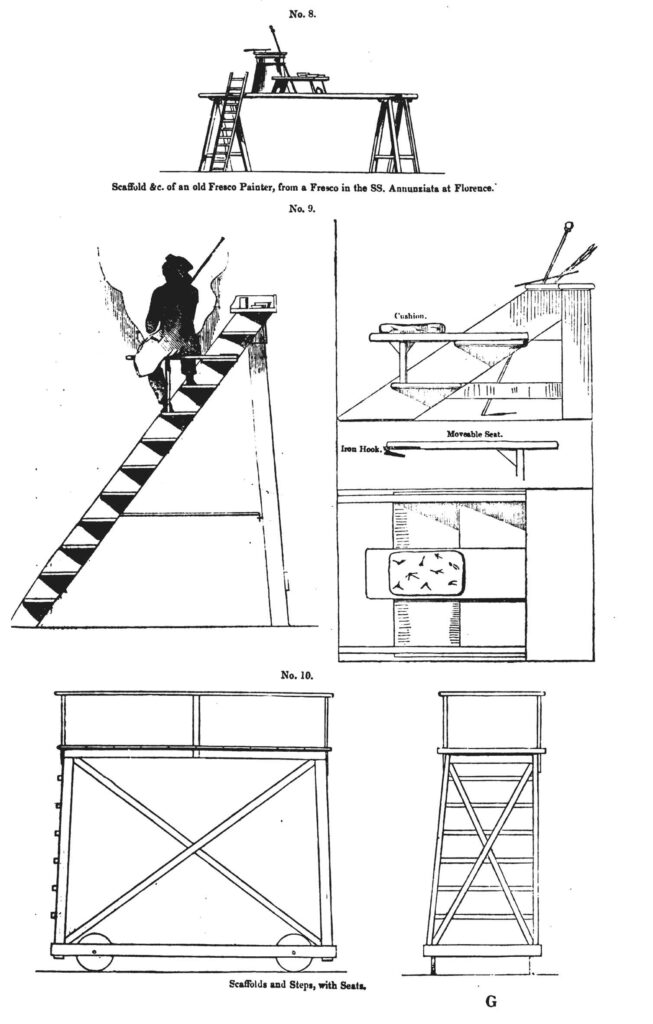
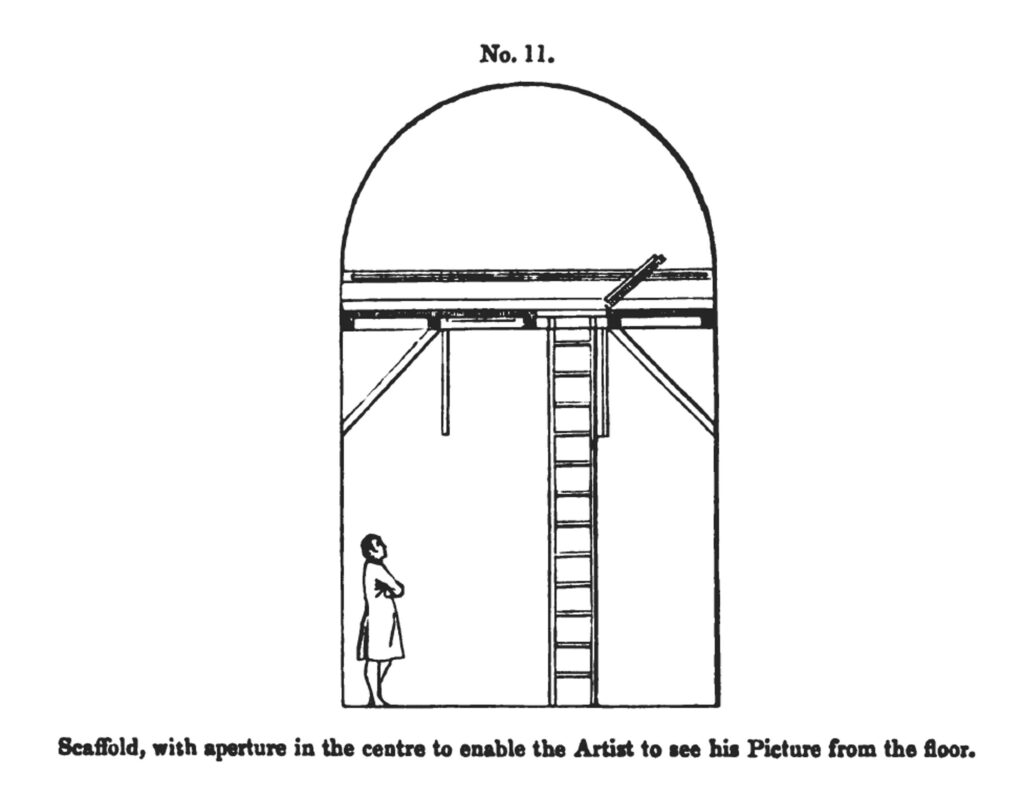
A letter, addressed to the writer of the above by S. A. Hart, Esq., R.A., lately returned from Italy, contains some interesting facts respecting the comparative durability of certain colours in fresco. The earths evidently stand best, while the blues, which are often imperfectly prepared mineral compositions, and the blacks (greys), which are generally animal and vegetable substances, have faded. Such consequences may suggest the use of fitter materials for these pigments. It also appears, that even the action of the sun does not rapidly obliterate colours prepared from earths, and to the employment of such materials probably the duration of external painted decorations in the hottest climates may be attributed. The following are extracts from Mr. Hart’s communication: –
“Over the altar of Santa Croce, in the chapel of the Incoronata in the Duomo at Mantua, is a very fine fresco by Andrea Mantegna, dated 1453, representing the Virgin and Child and St. Leonardo. It is painted on a ground laid on scagliola, (if not of that material some other composition imitating stone,) and is in perfect preservation; it was removed hither from another church called St. Gothard.
“On entering the Camera de’ Cavalli, in the Palazzo del Te, I was struck with the great truth shown in the imitation of the horses, six in number, of the natural size, painted in this room. The two bays are nearly as perfect in preservation as could be desired, while the three white and the remaining one, an iron grey, have suffered much. One of the white horses is now indeed a mere shadow. All the warm colours here have stood, while the cool have faded. These are said to have been painted by the pupils of Giulio Romano, Benedetto Pagni and Rinaldo Mantovano, from the designs of their master. The same scholars are said to have painted the ceiling of the Camera di Psiche in oil, representing various subjects taken from Apuleius’s fable. These, like the works similarly painted in oil in Rome by Sebastian del Piombo, (at Sta. Maria del Popolo, and S. Pietro in Montorio,) are turned black and heavy, especially in the shadows; a remark which cannot with equal truth be applied to the subjects in this room beneath in fresco, in which not more than a certain amount of depth is indulged in, calculated to give space and light to the apartment. The ceiling, on the contrary, looks ponderous and low.
“The subject of the banquet prepared for the marriage of Psyche is full of the nude, which though too red and false in colour, and dense in the shadows, is yet a good example in one respect, showing how the warm tints endure, especially in the flesh, where ochres and deep reds are employed. The greens also in the vegetation or landscape remain, while the sky and mountainous distance have subsided into a heavy indigo tone or a light slate colour. The ceiling pictures, which, as before stated, are painted in oil, are executed on a mortar laid on reeds placed on rafters crossing beams like our ordinary mode of lathing a ceiling.
“The gigantic figure of Polyphemus is tolerably preserved, and is a fine example of precision and finish on so large a scale. The restorations are very obvious, and show how much darker they are likely to become than the general colour they are intended to match.
“In the Camera de’ Giganti all the flesh-tints are again best preserved, while the skies and water have again faded to the usual blackish or slate colour; the yellows and greens having retained their colour. Here the intonaco, very thick, is seen in large blisters ready to detach itself from the wall. The outlines of these gigantic figures are boldly drawn with a point, and the execution exhibits great precision and finish. The joinings are all cleverly managed, considering their great scale, and are not readily perceptible without close scrutiny.
“In the fresco of the Ratto di Elena, in the room called that of the Siege of Troy, in the ducal palace at Mantua, the nitre has almost entirely eaten up all the greens and blues. Most of the other works in this chamber are in a similarly bad state, owing to the dampness which it is said was occasioned by the roof having been stripped of its lead in the year 1630, thus exposing these works to the effects of rain and frost. On rubbing these frescos with a moistened finger, and then applying it to the tongue, a strong nitrous taste was perceived. In this room again the grey horses, the armour of the soldiers, water, skies, and all objects in which cool tints have been employed, have faded.
“At Cremona, the southern transept of the cathedral has frescos attributed to Giorgio Casselli, and said to have been executed about the year 1301, (subjects from the Old Testament); they are more curious than fine in art, but interesting, from the fact of their having lasted so well, especially considering, as I hear from a native of the place, the dampness of the situation of the city, and its tendency to nitrous formations. Pordenone’s large Crucifixion on the wall inside the principal door is powerful to heaviness, yet as an instance of manipulation on a large scale worthy of attention. A thick intonaco appears in parts, spread on a wall built of marble, slightly roughened on its surface with a pointed instrument. The same kind of roughening, though not quite so regular, I observed on the walls of some houses in Assisi, in the street leading to the church of St. Francis, many portions of which had yet pictures adhering to them, and these were done at least by the school of Giotto.
“The church of St. Sigismund at Cremona is literally covered with the works of the brothers Campi; hardly a square inch has been left vacant. These frescos, bearing date many of them 1566–77, are all vigorous and brilliant, and are perhaps on the whole some of the best that could be adduced in favour of the material. Among other colours, a green of an emerald kind, and a most vivid blue, I have never before seen equally well preserved; they are especially brilliant here in an Ascension by Bernardino Gatto, called Il Sojaro, a pupil of Correggio. Probably this church was built of better materials, and on a dryer soil, as the walls with their decorations are in perfect preservation down to the very pavement. The walls of this church on the outside towards the garden, to an extent of six feet and a half, English measure, from their bases, have a pavement of red burnt bricks laid edgeways (the herring-bone form). Was not this probably done to prevent an attraction of moisture to the walls from any vegetation growing outside them, and may it not be partly owing to this precaution that the high state of preservation of the paintings down to the very pavement, a circumstance so very unusual, is to be attributed?
“In Brescia, a whole street, Il Corso del Teatro, has the fronts of the second floor story painted with a series of scriptural, mythological, and historical subjects, attributed to the Cavaliere Sabatti. They have suffered very much owing to their complete exposure to the weather, but here, once more, the warm colours have remained, and in many portions are thoroughly well preserved. Some of the actions of the figures in these subjects, judging from their remains, are very grand; and equally so is the style in which they are drawn; many of the deep but brilliant lake tones are worthy of a Venetian.
“The walls of the church of S. Zeno at Verona are painted to a great extent in fresco. The mortar, of a moderate thickness, has been laid on a stone resembling Portland stone, and over this first coat a thin layer like a wash has been applied for the ground of the painting. The face of the stone is slightly but very regularly roughened, as if with a toothed instrument, to hold the mortar. Some frescos in the choir, executed on brick surfaces, are the best preserved.
“The sacristy of Sta. Maria in Organo contains some beautiful studies, three half figures in every compartment (of which there are fourteen) of “padri Benedettini ed Olivetani,” all in white dresses, hooded, relieved on blue grounds, and all in the most perfect condition. Eighteen lunettes contain each two portraits of the popes who have been elected out of these orders. The blue grounds are relieved with gilding, and have stood perfectly. These works are all by Moroni. Vasari justly speaks of this place as one of the finest sacristies in Italy.
“I have observed constantly in churches that those works farthest removed from the ground have always endured best, and there is a strong proof of it in Verona, in one of the earliest built churches, S. Nazario, particularly in the works of Falconetto.
“On the walls of the cloisters of S. Stefano in Venice, unsheltered from sun or rain, are some remains of frescos by Pordenone. Those facing the west have stood the action of the sun’s light wonderfully well, being now as deep and bright as one can imagine them to have been when first done. The shadows look a little grey and misty, while the blue backgrounds on which the figures have been relieved are either turned black or purple, or have disappeared. Here the layers of mortar are thinly spread on a brick wall, and on the most exposed side, the west, have been but partially detached from the bricks. A female figure, in a deep rich red drapery has astonishingly preserved its colour; a yellow and part of a green drapery have lasted equally well; while a purple is nearly gone. The paintings on the south side, where the intonaco is more damaged, have as usual retained more of the warm vigorous tones than of the cooler hues. The flesh tints of all these pictures are worthy of Titian or Giorgione, and when the sun-light illumined them, their effect was most glowing. As most of the scenes represented are in the open air, with skies and landscape, these works again show how little such portions have resisted the influence of time.”
July 27, 1843.