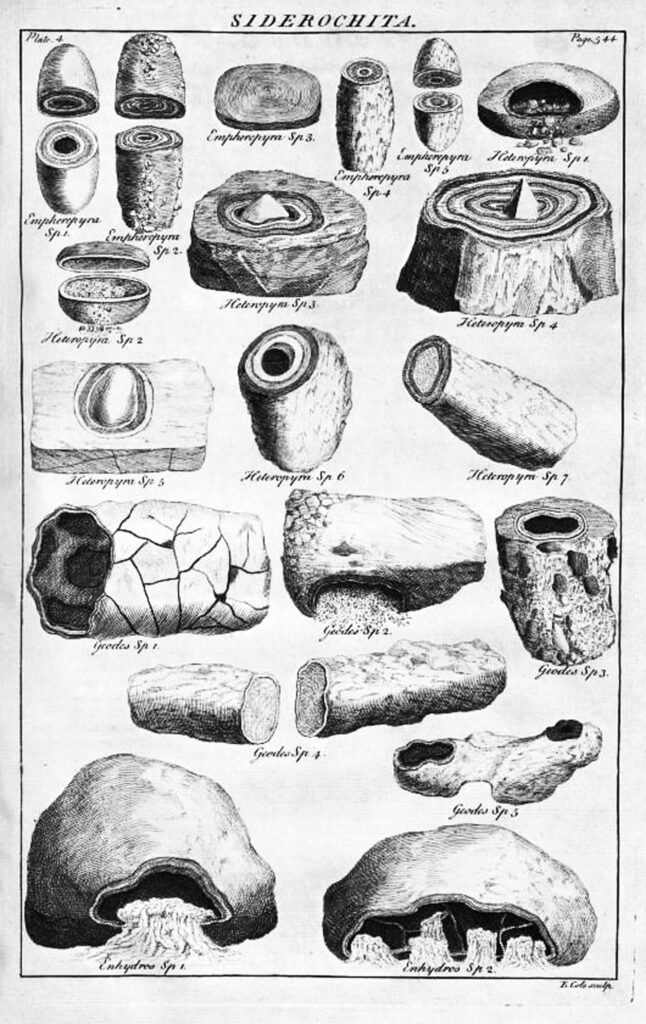
Hill 1748
John Hill, A General Natural History: or, New and Accurate Descriptions of the Animals, Vegetables, and Minerals, Of the Different Parts of the World; With Their Virtues and Uses, as far as hitherto certainly known, in Medicine and Mechanics, London [Thomas Osborne] 1748.
John Hill (1714?–1775) was an English physician, apothecary, naturalist, writer, and actor. Among other things, he devoted himself to botany and mineralogy. He translated Theophrastus’s History of Stones (1746) into English and authored various scientific treatises. After an unsuccessful attempt to be admitted to the Royal Society, he became one of its critics. In his General Natural History, published in London in 1748, Hill, among other topics, describes a number of coloured earths from which pigments were obtained.
THE
HISTORY
OF
FOSSILS.
PART the First.
Book I.
. . .
pp. 51–66
SIMPLE EARTHS.
Order the Second.
Those of rough, dusty surfaces, and a loose texture.
SERIES I.
CLASS I. ORDER II. GENUS. I.
OCHRES.
EARTHS slightly coherent, compos’d of fine, smooth, soft, argillaceous particles, rough to the touch, and readily diffusible in water.
SECT. I. The Yellow OCHRES.
1. Ochra levissima friabilis, pallidissime flavescens.
Light, friable, pale yellow Ochre.
This is a very pure, elegant, and beautiful Earth, of an extreamly pale yellow, even paler than what we call brimstone colour, of a middle degree, or between that and cream colour; of a loose, lax, and crumbly texture, and compos’d of a multitude of very thin fine plates, or strata, laid evenly and closely one upon another, and in nothing more remarkable than in its extream lightness; it is of an even but dusty surface, adheres very firmly to the tongue, is soft and smooth to the touch, easily crumbles between the fingers, and stains them with something a little deeper than a cream colour; it melts freely in the mouth, and leaves not the least grittyness between the teeth; thrown into water, it raises a great ebullition and hissing noise, but does not readily break in it of its own accord, tho’ it is easily mixt with it on rubbing, and spreads and diffuses finely in it.
The Microscope shews it to be of a dusty loose spungy texture, and finely laminated.
It makes no effervescence with Acids.
In the fire it separates its flakes more widely, and becomes very crumbly, and of a dull reddish brown.
It is found in Pensylvania and Virginia, from which places it has been sent over by John Bartran.
It is not at present known among the painters, but it is very much worth their being acquainted with; I have had it try’d both in water and oil, in both which it succeeds very well, making a pale straw colour in the former, and a very agreeable tho’ something deeper yellow in the latter.
2. Ocra ponderosa dura pallide flavescens.
Hard, heavy, pale yellow Ochre.
This is a very fine and beautiful Earth, and is much valued by the painters.
While in the stratum, it is of a fine bright yellow, somewhat hard and dry, and of a pretty firm and compact texture; it does not cut well with the spade, but is generally broke with pickaxes, and falls into irregular masses; when dry, it is of a pale but very bright and beautiful yellow, of a close, compact, firm texture, considerably heavy, and of a smooth, even and polite surface for an Earth of this kind; it adheres very firmly to the tongue, is soft and smooth to the touch, does not easily break between the fingers, and stains the hands with a very fine light yellow; it melts freely in the mouth, and leaves no harshness between the teeth; thrown into water it raises a considerable ebullition and loud hissing noise, but does not quickly break in it of itself, tho’ when mix’d it spreads very finely.
View’d by the Microscope, it appears of a somewhat more compact texture that the former, yet very loose and spungy.
It makes no effervescence with Aqua Fortis.
In the fire it burns to a stony hardness and dull pale red colour.
It is dug in Germany, Saxony, France, and England; our painters are very fond of it as it makes a fine pale yellow; but if they were once acquainted with the American kind, this would lose much of its value with them, as it is greatly inferior to that elegant Earth; they pretend to receive this Ochre from France, but in the way from Sherbourn to Bath, near Mendip-Hills, I saw people digging great quantities of it, which they told me were sent to Bristol, and thence to London for the colour shops; it lay at about 18 foot deep, in a stratum of a foot, or 15 inches thick; it mixes equally with water or oil. This and the other hard and somewhat smooth Ochres, evidently contain a small quantity of a fine Clay intimately mixed with and inseparable from them.
3. Ochra levissima flava friabilis.
Light, crumbly, yellow Ochre.
This is an Earth unknown to the painters, but well worth their being acquainted with; it is of a most loose, lax and crumbly texture, of a somewhat palish but not bright yellow, extreamly light, and of a rough, dusty surface; it adheres firmly to the tongue, is soft and smooth to the touch, crumbles readily to powder between the fingers, and stains the hands with a fair but not strong yellow; it melts freely in the mouth, and leaves not the least grittyness between the teeth; thrown into water, it raises a small ebullition, and makes a considerable hissing, but does not readily break in it.
View’d by the Microscope, it appears of a loose, open, spungy texture.
It raises no effervescence with Acids.
In the fire it burns to a very fair red.
It is frequently thrown out at the mouths of Chalybeat springs, and sometimes from such as are not manifestly impregnated with that metal, and often forms incrustations on sticks and other things in its way, in the manner of the Osteocolla; it lies in great abundance at the mouth of a small spring on the right hand side of Hampstead-Heath, near the hedge parting it from the pastures; it has not yet been us’d by the painters, but is very worthy the trying.
4. Ochra levis aurea friabilis, quæ Ochra Theophrasti.
Light, friable, gold colour’d Ochre, the Ochre of Theophrastus.
This is the Ωχρα Theoph. Ed. Nost. 184, it is a very fine Earth, and tho’ not yet in use, makes an excellent and bright gold colour.
It never constitutes a stratum, but is ever found loose in form of a small natural nodule, ‘tis of a very fine and strong tho’ not deep yellow, of a loose shattery texture, and very light; it is of a rough, uneven and dusty surface, adheres very firmly to the tongue, is soft, fine and smooth to the touch, easily crumbles between the fingers, and stains the hands to a true gold colour; it melts freely in the mouth, and leaves not the least grittyness between the teeth; thrown into water, it makes a great ebullition and loud hissing noise, but like the former does not of itself readily break or diffuse in it.
View’d by the Microscope it appears of a loose, spungy, and dusty texture.
It makes no effervescence with Aqua Fortis.
In the fire it burns to a very elegant red, with a little additional hardness.
It is frequent among gravel, and in the perpendicular fissures of other strata, in many parts of the kingdom, and is sometimes found in the same places, enclosed in the ferrugineous crustated Geodes to be hereafter described; on Mendip hills it is common in the fissures of the strata; and in a gravel pit on the right hand side of the Oxford road, about a mile from London, there is always great plenty of it, some in masses of four, five, or fix ounces weight alone, and some contain’d in the bodies before mention’d, with which that pit abounds.
I remember also to have seen it in some places hanging to the sides, and from the tops of old mines, or other cavities, something resembling rude Stalactite; which particular Dr. Woodward also observ’d of an Ochre probably the same, and mentions it, vol. 2. p. 1. Sp. a. 4. and not unfrequently in masses of three or four ounces weight, in beds of chalk. The before mentioned author describes also another Ochre, as he esteems it, which he had found in the same manner lodg’d in chalk, in very large quantity. I cannot take upon me to contradict any one’s personal observation, but cannot but remark, that wherever I have found pure Ochre in chalk, or encrusted on, or hanging from caverns, it has been always of this kind; no other that I have yet seen being liable to appear to us in so many shapes, and likely to mislead us into the making two or three species of it, from its very different external appearance. Many other Fossils there are, which may, on their first appearance, be apt to mislead the observer in the same manner: but if they answer to all the tests propos’d in these descriptions, in the same manner and degree one with another, a judicious examiner will never think them different species, because of their being round, square or flat; the matter of every species of Earth, when pure, must be for ever the same, the particular shape of them may be alter’d by a thousand accidents.
It is as yet unknown to the painters, but I have had it try’d both native, as a yellow, and burnt as a red, and find it exceed all the Ochres they use in both these conditions; and as it may be had for going for, and that within half an hour’s walk of London, I hope some of the gentlemen of that profession will think it worth a tryal.
Theophrastus Ed. Nostr. 124. mentions Ochre as being frequently us’d in the place of Orpiment; the particular species was probably this, since none of them approach so much as this to the fine gold colour of Orpiment; and indeed the powder of this scarce differs at all in colour from that of the more common ordinary and cheap Orpiment of our colour shops, which is a particular that author also so long ago observed, Καὶ Ώχρα ἀντ᾿ ᾿Αῤῥενικῶ, διὰ τὸ μηδὲν τῇ χρόᾳ διαφέρειν.
5. Ochra crocea laminata levis, quæ Ochra Attica Dioscoridis.
Light, plated, Saffron-colour’d Ochre, the Ochre Attick of the antients.
This is another of the yellow Earths, easy to be had, and worthy the consideration of the painters.
It is found at some times constituting a stratum of itself, at others lodg’d in the perpendicular fissures of other strata, and in some places lying in loose nodules among gravel. It is of a fine deep but bright yellow, like that which saffron gives to water, and sometimes is found slightly spotted with red: it is of a soft, shattery, friable texture; and always compos’d of a multitude of Laminæ, or thin plates, laid closely on one another, and is remarkably light. It is of a rough, uneven, dusty surface, it adheres firmly to the tongue, is soft and smooth to the touch, easily breaks between the fingers, and stains the hands with a very glorious yellow; it melts freely in the mouth, and leaves no harshness between the teeth; thrown into water it makes a violent ebullition, and loud hissing noise, but does not readily moulder away in it.
View’d by the Microscope it appears of a loose, spungy, dusty texture, but regularly and finely laminated.
It makes no effervescence with Aqua Fortis.
In the fire it burns to a dusky red, with no additional hardness.
It is common in Northamptonshire, and Staffordshire, and about London; I have had it try’d as a paint; when unburnt it makes a most beautiful yellow, either in water or oil, but wants what the painters call a body; burnt to a redness it does not succeed so well, the colour having no brightness.
As the former was probably the Ochre of Theophrastus, this seems to have been that of Dioscorides, which was also greatly in repute among the antient painters, and call’d from the place whence it was brought in greatest quantities and purity, Ochra Attica. The description of that substance left us by this author agrees with this species in every particular; he says, it was very light, yellow throughout, and of a fine strong colour, and not gritty, or containing particles of stone, but brittle. All which are exactly the qualities of this species of Ochre.
This species Ochre, known to the painters among the antients under the name of Ochra Attica, became afterwards confounded with a substance extreamly different from it in every particular, the Sil Atticum of the antients, of which hereafter; Vitruvius evidently has mistaken them for the same substance; and since his time many who cou’d not reconcile the Ochre to all the qualities mentioned of the Sil, yet have imagin’d that that substance was yellow, which is evidently erroneous: Cæsalpinus observ’d, that the Sil and Ochre seem’d to be different substances, and takes notice, that Pliny mentions them with different qualities, and allots different countries to them, Videtur autem aliud intelligere Sil & Ochram, de Ochra enim inquit ex Juba, nasci in insula maris rubri sed inde non advehi ad nos, at de Sile alias regiones recenset ex quibus habebatur Pigmentum necessarium ad Lumina & Umbras. Thus far this author had learn’d to distinguish the Sil from the Ochre, but he concludes his account with a double error, not only mistaking the Sil for a yellow, but erroneously judging it the Giallolino, hereafter to be describ’d: And even quite mistaking the origin of the Giallolino itself; which instead of a native yellow Ochre, he esteem’d a factitious thing, a preparation of lead. Quod hodie arte paratur ex Plumbo usto vulgoque Giallolinum appellatur. A yellow paint is indeed prepar’d from lead, by a slight calcination of ceruss, and is now in use among the painters, under the name of Masticot; the Giallolino they have also frequently in use, and distinguish it by the name of Naples yellow.
The ancients not only estem’d this as a paint, but had it in frequent use in external compositions in Inflammations, Tumours, &c.
6. Ochra ponderosa flava friabilis.
Heavy, friable, yellow Ochre.
This is the common yellow Ochre of the shops; it is the Ochra Mer. Pin. 218. Ochra Anglica, Worm. 17. Ochra Nativa Calc. Mus. 137. Ochra Fossilis sive nativa Crocei Coloris, Dougl. Ind. 64.
It is a dense and ponderous Earth: while in the stratum it is of a deep yellow, moderately moist, and of a close texture; it cuts evenly thro’ with the spade, and leaves a smooth, but not glossy surface behind it; when dry it is of a much deader yellow than any of the before describ’d, of a close firm texture, and even, but dusty surface; it adheres firmly to the tongue, is soft and smooth to the touch, breaks tolerably easily between the fingers, and stains the hands with a dusky yellow; it melts freely in the mouth, and leaves no grittyness between the teeth.
Thrown into water it raises a considerable ebullition, with a slight hissing noise, and immediately swells in bulk, and moulders into a fine soft powder, as quick as the common fullers earth.
View’d by the Microscope it appears of a very regular, but loose, spungy texture.
It makes a considerable effervescence with Aqua Fortis.
It burns to a fine bright red with very little additional hardness.
It is dug in Buckinghamshire, Somersetshire and Oxfordshire, and is the yellow Ochre principally in use among the painters, tho’ greatly inferior in value to most of those before describ’d.
7. Ochra argillacea ponderosa lutea dura.
Hard, heavy, clayey, yellow Ochre.
This is a very dense, compact and weighty Earth, and like some other of the more compact Ochres, has evidently some particles of a true fine Clay among it. While in the stratum it is of a very beautiful strong yellow, of a close compact texture, firmly coherent, and in some degree stiff or viscid; it cuts easily and evenly thro’ with the spade, and leaves a smooth and something glossy surface behind it: When dry, it is of a very fine bright yellow, of a dense, close and compact texture, and a smooth, even and glossy surface; it adheres firmly to the tongue, is soft, smooth, and somewhat unctuous to the touch, is not easily broken between the fingers, and but slightly stains the hands with a fine pale yellow; it melts freely in the mouth, leaving no grittiness between the teeth: Thrown into water it makes a considerable ebullition, and hissing noise, and immediately swells in bulk, soon after breaking into a multitude of thin flaky pieces, and thence falling into a fine yellow powder.
View’d by the Microscope it appears of a close, compact, and very fine texture.
It makes no effervescence with Aqua Fortis.
It burns to a very fair red, with a considerable hardness, but crackles and bursts in the fire.
It is dug in Buckinghamshire, Yorkshire, and some other places, and sometimes sent up to London, and us’d by the painters. I have had it try’d both native and burnt, and find that it makes both ways a very good and useful colour.
8. Ochra durissima ponderosa flava.
Stony, hard, heavy, yellow Ochre.
This is the hardest of all the Ochres. While in the stratum it is of a dead, dusky and somewhat deep yellow, very dry, and so hard as not to be cut with the spade, but must be dug with pickaxes, it breaks in the digging into rude irregular masses, of rough unequal surfaces, and very great weight; when dry it is of a something paler and brighter colour, of a close compact texture, and almost stony hardness, of a rough irregular surface, adhering very firmly to the tongue, and hard, harsh and dry to the touch, it is not to be broken between the fingers, and but slightly stains the hands; it melts readily in the mouth, and leaves no grittyness between the teeth; thrown into water it makes very little ebullition and no hissing noise.
View’d by the Microscope it appears of a rough but very firm texture.
It makes no effervescence with Aqua Fortis.
In the fire it crackles a little, and burns to a fine florid red, with little or no change in its texture. It is evidently compos’d of an ochreous matter, lock’d up as it were in a considerable quantity of an indurated Clay, which so far prevails in the mass asto keep it, tho’ truly an Earth of this class, from exerting many of the properties which make the characters of it.
It is dug in Buckinghamshire, Staffordshire and Yorkshire, but most plentifully about Oxford; whence it is constantly sent in great quantities to London for the use of the painters.
9. Ochra argillacea sordide flavescens.
Dull, dusky yellow, clayey Ochre.
This like the former, is an Ochre embodied in a considerable quantity of a true genuine Clay, and thence carrying many of the marks of that class of bodies; a few mix’d bodies of this fort there will be in almost every class, such has been the mixture of these things at their original coalescence, and these perplex the Genera they are plac’d among; all that can be done with such, is, to class them among those substances, the nature of which, from the superior quantity of particles of that kind is predominant in them.
This is a dense, compact and weighty Earth; while in the stratum it is of a dusky but not very deep yellow, of a stiff but somewhat crumbly texture, and is not to be cut thro’ evenly with the spade, but falls into irregular masses; when dry it is of a somewhat paler, but dusky and unpleasant colour; of a firm, compact, close texture, and irregular but smooth surface: It adheres very firmly to the tongue, is smooth and unctuous to the touch, is easily crumbled to pieces between the fingers, and slightly stains the hands; it melts freely in the mouth, but has a little grittiness between the teeth; thrown into water it raises a slight ebullition, with a very small hissing noise, and in a few minutes swells in bulk, and afterwards falls into small plated fragments, and thence into a fine yellow powder.
View’d by the Microscope it appears of a compact but somewhat dusty texture.
It makes no effervescence with Acids.
It burns to a very fine pale red, of an almost stony hardness, but is very apt to crackle and burst in the fire.
It is to be observed, that this and all the other yellow Ochres, when first taken out of the fire, look of a deep, rusty chocolate colour; but as they cool they become more and more red, and shew not their true colour till absolutely cold.
This is found in Buckinghamshire, Staffordshire, Oxfordshire and Northamptonshire; and is sometimes brought to London and sold in the colour shops.
10. Ochra argillacea luteo fusca levis.
Brownish yellow, light, clayey Ochre.
This is another of the impure Ochres, but contains much less Clay than the precedent.
It never forms a distinct stratum, but is found in detach’d pieces among other strata, and sometimes in the perpendicular fissures of them. It is of a pale brownish yellow, but not a disagreeable colour; of a smooth, even and perfectly fine texture, and plain and something glossy surface, and very light; it adheres very firmly to the tongue, is dry but soft to the touch, breaks tolerably easily between the fingers, and but slightly stains the hands; it melts freely in the mouth, and leaves no grittiness between the teeth; thrown into water it raises a considerable ebullition and hissing, but does not of itself break or moulder quickly in it.
View’d by the Microscope it appears of a close, even and regular texture.
It makes no effervescence with Aqua Fortis.
It burns to a dead dusky brownish red.
It is found in Buckinghamshire, Northamptonshire and many other counties; and tho’ not of so bright a yellow as many of the other Ochres, yet is a very pleasing colour, and has what the painters call a good body; I have seen of it of particular fineness in the fissures, and among the rocks about mount Sorrell in Leicestershire; and about London, it is frequently thrown up out of the clay and gravel pits in lumps of three or four ounces weight.
11. Ochra ponderosa friabilis aureo crocea, quæ Giallolino authorum.
Heavy, friable, fine yellow Ochre, call’d Naples yellow.
This is a valuable, and extreamly beautiful Earth. It is of a most bright and elegant colour, between what we call a gold and a saffron colour, of a very loose, spungy, porous and shattery texture, and remarkably heavy; it is of a rough, uneven, spungy and dusty surface, it adheres but very slightly to the tongue, is rough and gritty to the touch, very easily crumbles between the fingers, and slightly stains the hands, breaks freely in the mouth, is of a manifestly saline taste, and feels hard and harsh between the teeth; thrown into water it makes a great ebullition and hissing noise, and deposits a small quantity of fine yellow powder all about it, but does not readily moulder or crumble to pieces.
View’d before the Microscope it appears of a most loose, incoherent and spungy texture.
It makes a very brisk effervescence with Aqua Fortis.
It burns to a deeper yellow but with no tendency to redness.
It is found in some parts of Italy, particularly about Naples, sometimes on the surface of the earth, and sometimes at considerable depths; much of it is brought thence for the use of the painters, who esteem it a very fine colour.
The antients I have before observ’d at Nº 5. of this Section, were well acquainted with yellow Ochres as paints; ‘tis plain from Theophrastus also, that they well knew the method of making a red from them by burning: That excellent author has even given the exact process, and ascribes the invention of it to accident; as, wou’d the vanity of men allow it, most of the great inventions in the world have probably been owing to them.
The way of making it he tells us was this, they put the Ochre into new earthen vessels which they cover’d with Clay, and set in furnaces; these as they grew hot, heated also the Ochre, and the greater the degree of fire was, the stronger red the matter acquir’d. The invention he says was Cydias’s, who took the hint of it, as was reported, from observing in a house which was on fire, that some of the Ochre which was there when half burnt assum’d a red colour.
One wou’d be apt to imagine, that after so express and plain an account as this, of this manufacture of the antients, there cou’d not well have been any errors about it among those who wrote afterwards; but we find many authors of credit and reputation falling into strange errors concerning it since. We see Pliny speaking of it says, after he has been naming the Rubrica or Reddle, that Ochre was made from it by burning; not that it was made from Ochre, and that the more it was burnt the better it was; ex ea fit Ochra, exusta rubrica in ollis novis luto circumlitis quo magis arsit in Caminis hoc melior. One wou’d wonder that such an account as this, so plainly contradicting not only the antient fathers of knowledge, but even reason and common experience also, and which every painter’s boy must have been able to laugh at, cou’d have a place in a work generally thought of much credit: But what is much more wonderful in regard to it, is, that such is the zeal of propagating errors in natural knowledge, as I have elsewhere had occasion to observe, that tho’ the antients contradicted this assertion, and common experience prov’d it false every day, yet Isidore Lib. 19. Cap. 7. and Cardanus L. 5. have repeated and avow’d it almost in the same words.
I have had occasion to observe in Pliny so many inaccuracies, and careless translations from Theophrastus particularly, that I am far from thinking it impossible that he might have originally given us this passage as it now stands. Salmasius however, is good natur’d enough to attempt an emendation of the text, and imagines it ought to stand thus, Ochra, ex ea fit exusta Rubrica & fit ex Ochra exusta in ollis novis luto circumlitis. It is easy to see that Pliny’s account is a translation, such as it is, from Theophrastus; but I don’t know whether the critics will allow so bold an emendation as this. If we may have leave to undertake all the errors of Pliny in this manner, and be permitted to make him say exactly the contrary to what he does say, we may certainly soon make him one of the best authors in the world.
SECT. II. The Red OCHRES.
1. Ochra rubra friabilis ponderosa, Sil Syricum Antiquorum.
Friable, heavy, red Ochre, The Sil Syricum of the Antients.
THIS is an earth of small price with us, but of great use among the painters. It is of a loose, irregular texture, and of a fine colour and great weight; while in the stratum it is moderately moist, cuts easily but not evenly thro’ with the spade, leaves an irregular surface behind it, and generally falls in rude masses; when dry it is of a fine strong red, of a loose friable texture, and very rough and dusty surface: It adheres very firmly to the tongue, is somewhat soft to the touch, crumbles easily between the fingers and stains the hands; it melts freely in the mouth, has a strong astringency to the taste, and leaves a very considerable grittyness between the teeth; thrown into water it raises a great ebullition with a considerable hissing noise, and immediately moulders into a fine soft powder.
View’d by the Microscope it appears of a loose crumbly texture, and is seen to contain a considerable quantity of a small, pale yellow sand.
It makes no effervescence with Aqua Fortis.
In the fire it crackles a little, and acquires a considerable additional hardness and much paler colour.
It is dug in many parts of Wiltshire, Dorsetshire and Somersetshire, and sent to Bristol, from whence the colour shops in London are supply’d with it. I have seen of it also in Lincolnshire, Northamptonshire and Buckinghamshire, but seldom pure.
It is much us’d in painting, especially about the coarser works, tho’ it is possible to make a colour from it fine enough for the most elegant.
2. Ochra purpurea friabilis Alkalina, Almagra Recentiorum, Sil Atticum Antiquorum.
Friable, purple, alkaline Ochre, the Almagra of the Moderns, and Sil Atticum of the Ancients.
This is an Earth of a very fine colour, of a loose, lax texture, and great weight; while in the stratum it is of a fine deep purple, of a friable but very dense, and seemingly compact texture, cutting unevenly with the spade and tumbling away in large rough masses.
When dry it is of a somewhat paler colour than while in the stratum, but of a fine and very deep red, of very considerable weight, of a dense, compact, but yet very friable texture, and rough dusty surface. It adheres very firmly to the tongue, is dry and something harsh to the touch, very easily crumbles between the fingers, and stains the hands; it melts freely in the mouth, is of a very strongly astringent taste, and leaves a little grittyness between the teeth; thrown into water it raises a slight ebullition, but without any hissing, and gradually swells in bulk, afterwards falling into a number of small flat pieces, and thence into a fine purple powder.
View’d by the Microscope it appears of a very fine and even texture, but full of a very glossy, pale brownish sand.
It makes a violent effervescence with Aqua Fortis.
In the fire it acquires a much paler colour, without any change in its texture.
It is found in immense quantities in many parts of Spain: in Andalusia there are in a manner whole mountains of it. It is us’d in painting, and as an Astringent, with very good success.
This seems to have been the Sil Atticum of Pliny, which he describes to be a kind of mud or earth. Sil proprie limus est, Optimum ex eo quod Atticum vocatur. The antients had three kinds of Sil; the Atticum, the Marmorossum, and the Syricum. The Attic was accounted the best, the Marmorosum the next, and the other was less valued as of a more dusky colour. All accounts seem to make the substance here described the Attic kind. And the Sil Marmorosum Salmasius imagines to have been the shining red arenaceous Cinnabar of Theophrastus. That great Critic wou’d have this word written Marmorisum; and deduces it from the μαρμάριζον of the Greek; which he would have here express, a sand of a glittering appearance like marble. And then declares it not badly expresses what Theophrastus calls the shining sand, which was his Cinnabar. Marmorisum a marmoris nitore quasi marmoreal Arena, quæ non male refert τὴν λαμπυρίζεσαν ἄμμον. Theophrasti. And adds, Nec differebat color Silis & Minii.
With all due deference, however, to the character of that excellent writer, I cannot but look on all this as a very unwarrantable conjecture, and forc’d construction. Pliny could never mean to give his readers any idea of sand, by the epithet Marmorosum. And had the substance he meant to describe been a sand, or any thing in that form, wou’d certainly have mention’d so particular a circumstance. I rather chose to understand the Marmorosum of that author, as signifying according to its plain construction a substance in hardness, texture, and substance resembling marble: And as I am well acquainted with a red Ochre of that nature and texture, which is hereafter to be describ’d under the name of Ochra saxea rubra, make no doubt but that was the Sil Marmorosum of Pliny; and am ready to believe, that had this excellent critic ever happen’d to see this substance, or know that there was such a substance in the world, he wou’d have been of the same opinion, and sav’d himself the forc’d conjecture before mention’d: The last kind or Syricum, which was hitherto generally printed Scyricum, but which father Hardouin has restor’d to its true reading, was probably the Ochra rubra friabilis ponderosa, described before.
This Gentleman, however, who deserves greatly of the learned world for his edition of that author, has been led into the error of confounding the Sil Atticum, and Ochra Attica with one another; which is not to be wonder’d at as so many authors of credit had done it before, and this particular part of natural history does not appear to have been the peculiar study of that editor.
3. Ochra purpurea ponderosissima dura.
Hard, heavy, purple Ochre.
This is the Terra Persica. Lem. Ind. 541. and is commonly call’d Indian red among the painters.
It is a very fine purple Earth, of firm, compact, hard texture, and great weight; while in the stratum it is of a pure blood colour, and almost of a stony hardness; it is not to be cut by a spade, but is dug with large iron crows, and falls in great irregular masses; when dry it is of a fine glowing red, extreamly heavy and of a very great hardness, of a rough dusty surface, and when broken full of considerably large, solid, bright, glittering particles, these are white; and of a fine lustre, and pretty equally dispers’d thro’ the whole masses of this Earth, but do not shew themselves on the surface, because of a loose powder which that is always cover’d with; it adheres very firmly to the tongue, is rough and harsh to the touch, is not to be broken between the fingers, and very deeply stains the hands; it melts slowly and difficultly in the mouth, and is of a rough, austere and very astringent taste; thrown into water it makes a considerable ebullition with a slight hissing noise, but does not readily diffuse or break in it.
View’d with the Microscope it appears of a loose, harsh texture, and the shining particles are very evidently seen to be fragments of a fine hard Spar; they are of different sizes, but always approaching to a rhomboidal figure, generally of a pure white, but sometimes faintly colour’d with green or yellow, and, which is something odd, never that I observ’d with purple.
It makes a very considerable effervescence with Aqua Fortis.
In the fire it burns to a greater hardness with very little change of colour.
It is dug in the island of Ormuz in the Persian gulf, and thence dispers’d over all the East-Indies; twice I have receiv’d this Earth from Bombay, with accounts of its being dug there; but suppos’d them erroneous, till about fix months since, I receiv’d a third parcel of it by the hands of Mr. Smyth, who assures me, that he has seen the place. It is us’d greatly in painting, but not in medicine.
4. Ochra friabilis floride rubescens.
Bright red, friable Ochre.
This is also an Earth much esteem’d in painting in many parts of the world, but less known in England than other European nations.
It is of a fine, bright, florid red, of a dense, compact yet friable texture, and moderately heavy; of an even but dusty surface, smooth and soft to the touch, and adheres very firmly to the tongue; it easily crumbles between the fingers, and readily stains the hands; it melts but slowly in the mouth, and is very fine, leaving scarce any harshness between the teeth; thrown into water it raises a considerable ebullition with a slight hissing noise, and moulders into a fine red powder.
View’d by the Microscope it appears of an even, smooth texture, and containing a very small quantity of an extreamly fine sand, of a pale brown colour, with a slight blush of reddishness, not unlike one of the Hampstead heath sands, to be describ’d hereafter.
It raises a very strong effervescence with Aqua Fortis.
It suffers very little alteration in the fire.
It is dug in vast quantities in the country above Bengall, and us’d in France and Germany as a fine red in painting; it is but little known in England, but I believe wou’d prove, if our painters wou’d give it a trial, at least equally good with any red Earth they have in use.
5. Ochra friabilis pallide rubescens, quæ Bolus Veneta vulgo.
Pale red, friable Ochre, called Venetian Bole.
This is an Earth universally known and greatly esteem’d among painters. While in the stratum it is of a fine bright red, moist as the softer of the clays, but not stiff or viscid; it cuts easily and evenly thro’ with the spade, leaves an even but not glossy surface behind it, and falls in somewhat compact masses; when dry it is of a fine bright but very pale red, in comparison of the Ochres before describ’d, and something approaches to the colour of red lead, moderately heavy, of an even, and smooth, but not very firm texture, and of a dusty surface. It adheres firmly to the tongue; is soft, fine and smooth to the touch, pretty easily crumbles between the fingers, and very much stains the hands; it melts very freely in the mouth, has a little astringency in taste, and leaves a slight grittyness between the teeth; thrown into water it raises very little ebullition, and that without any hissing noise, and slowly moulders into small lumps and thence into powder.
View’d by the Microscope, it appears of a dusty, rough texture, and full of a fine yellow sand.
It makes no effervescence with Aqua Fortis.
In the fire it burns to a considerable hardness and deader colour.
It is dug in Carinthia, and is sent from Venice into all parts of the world, being universally known as a paint.
6. Ochra friabilis levis pallide rubescens alkalina.
Light, friable, alkaline, pale red Ochre.
This is a very fine and valuable Earth, at present unknown in painting, but very easy to be had, and worth the bringing into use.
While in the stratum it is of a very pale but bright red, and of a loose incoherent texture; it cuts easily thro’, but leaves a rough surface, and falls in irregular pieces; when dry, ‘tis of a very elegant pale red, much like that of the Venetian Ochre, but brighter and something paler; it is very remarkably light for an Earth of this kind, and of a loose crumbly texture; it is of an even but dusty surface, it adheres slightly to the tongue, easily breaks between the fingers, and stains the hands; it melts freely in the mouth, is of a sub-astringent taste, and leaves very little hardness between the teeth; thrown into water, it makes a considerable ebullition and hissing noise, and presently falls into a fine soft powder.
Examin’d by the Microscope it appears of a smooth even texture, but perfectly pure; no glass I could ever use, being able to discover what were the few hard particles it contain’d.
It makes a very brisk effervescence with Aqua Fortis.
In the fire it burns to a duller colour, with very little additional hardness.
It was thrown up in digging after an imaginary gold mine in Florida, near the shores of the gulf of Mexico some years since; it lay there very deep, but probably is in many other parts of America, and easier to be come at; it has not yet been known in painting, but I have had it try’d, and find it a very valuable and elegant colour.
7 Ochra argillacea pallidissime rubescens.
Pale, Red, Clayey Ochre.
This is a Clayey Ochre of a considerable weight, but of a loose friable texture; it is of a very pale red, approaching to what we usually call a flesh colour, of a loose rough texture, and uneven, irregular, but not dusty surface; it adheres very firmly to the tongue, is smooth and unctuous to the touch, breaks very easily between the fingers, and slightly stains the hands; it melts readily and freely in the mouth, is insipid to the taste, and leaves a great harshness between the teeth; thrown into the water, it makes a very considerable ebullition with a loud hissing noise, and immediately falls into a fine soft powder.
View’d by the Microscope, it appears of a loose, spungy texture, and full of a large coarse white sand.
It makes no effervescence with Aqua Fortis.
In the fire it burns to a very fair red, without any additional hardness.
It is common in Pensylvania and Virginia, and has been sent from both those places by John Bartran; it is yet made no use of, but wou’d serve all the purposes of the Derbyshire Reddle before describ’d.
8. Ochra purissima levis purpurascens.
Fine, light, purple Ochre.
This is an Earth very worthy the attention of the painters; it never constitutes a stratum of itself, but is found in the perpendicular fissures and horizontal cavities of those of harder matter; it generally lies in these in lumps of uncertain figures, and from two to fix ounces in weight; it is of a very fine purple in colour, of a most smooth, even and regular texture, and remarkably light; it is of an even, but somewhat dusty surface, adheres very firmly to the tongue, crumbles easily between the fingers, and stains the hands with a bright blood colour; it melts freely in the mouth, and is perfectly pure, leaving not the least grittyness between the teeth, and is of a strongly astringent taste; thrown into water, it makes a slight ebullition without noise, and does not of itself readily moulder away into powder.
View’d by the Microscope, it appears of a most even, fine and pure texture.
It makes no effervescence with Aqua Fortis.
In the fire it acquires a something paler colour, without the least additional hardness.
It is common in the perpendicular fissures of the strata, where there is iron ore, I have seen it in Sussex, about Bristol, and in great quantities in the forest of Dean in Gloucestershire; it is not much known among the painters, tho’ from the last place a considerable quantity is at times sent to London; one or two of the colour shops in-gross it to themselves, and fell it under the name of Indian red, to which it is at least equal in colour, and much superior in the fineness of its particles, as all Earths found in the perpendicular fissures, must greatly excel those of the strata in this particular.
9. Ochra purpurea purissima ponderosa, quæ Rubrica Sinopica Antiquorum.
Fine, heavy, purple Ochre, called Rubrica Sinopica.
This is the Rubrica Sinopica Math. 1359. Rubrica Sinopis. Agric. 583. Terra Sinopiana Tourn. Voy. Vol. 2. 159. Rubrica Sinopica Cæsalp. 35. Sinopis. Plin. L. 2. p. 685.
The Μίλτο Σινοπική. Theophrast. Ed. Nostr. 126.
It is a very pure, fine and valuable Earth, and very worthy the attention both of the painters and the physicians.
It is a close, compact and very weighty Earth, of a fine glowing purple colour, but in some specimens much deeper than in others, and in some degenerating into paleness, but even in its worst condition a very fine colour; it is of a pure texture, but not very hard, of an even but dusty surface; it adheres firmly to the tongue, is perfectly fine and smooth to the touch, does not crumble nor easily break between the fingers, and stains the hands; it melts very slowly in the mouth, and is perfectly smooth and fine, of a very austere astringent taste, and leaves not the least grittyness between the teeth; thrown into water, it makes a considerable ebullition with a loud hissing noise, and soon falls into a very fine purple powder, which readily diffuses itself thro’ a vast quantity of water.
View’d by the Microscope, it appears of a close, compact, even texture.
It makes a considerable effervescence with Aqua Fortis.
In the fire it burns to a great hardness, without change of colour.
It is found in the perpendicular fissures of the strata of stone, and among iron ores, sometimes lying at great depths, and sometimes up to the surface, and that in many different places; in England indeed I cannot say, that I have yet had the fortune to find it, but am very apt to believe it is not wanting here: Tournefort imagines, that it was formerly found about the city of Sinope, from which it had its name, but I find no account of any such thing; Theophrastus expressly says, that it was a Cappadocian Earth, tho’ call’d Sinopic, because the city of Sinope was the mart for it, the principal place where it was carried for sale, Και ἣν καλῶσιν Σινοπικήν˙ αυτη δ’ εσίν ἡ Καπαδοκική· καλάγεται δεις Σινόπην. Ed. Nostr. 126. which seems to imply very plainly, that it never was dug any where about Sinope at all: Pliny imagines indeed, that it was originally found in Pontus, but none of the antients bear him out in this; Dioscorides, who was well vers’d in the history of the Materia Medica of his time, and who liv’d at a time when it was even more us’d than in the days of Theophrastus, agrees perfectly with that author, as to the place where it was produc’d, affirming that it was taken up in Cappadocia from certain caverns, and carried to the town of Sinope, and there sold.
Cappadocia seems therefore to have been the only place where this Earth was dug in the times of the earlier writers; afterwards, however, according to Pliny, it was found in Ægypt, Africa, and the Insulæ Baleares, our Majorca and Minorca; Nascitur & in Ægypto Balearibus Africa, L. 35. p. 685. Vitruvius also assigns it the same places, and I have of late receiv’d it from the New Jerseys in America, where it is well known by the name of Bloodstone, probably from its staining the hands, and very probably it may be had in many other places; and this indeed deserves enquiring thoroughly into, since perhaps there is not one among the Earths that is more worthy notice: its being form’d in the perpendicular fissures of the strata makes it necessarily of extream fineness, as no particles but such as were so, cou’d find their way thither; there may indeed be possibly strata of an Earth like it, but these must afford it in much worse condition; and this Pliny has very well remark’d, declaring that to be the best which was found adhering to stone; Quæ saxis adhæsit excellit, that is, such as was found in the perpendicular fissures.
This fine texture and its high florid colour, must make it very valuable to the painters, and its great astringency with the same advantages, equally so in medicine; the antients were well acquainted with it as an astringent, in Fluxes and Hæmorrhages of all kinds, and I can from experience warrant its possessing the same virtues yet, and that in a very eminent degree: I have always observ’d, that the deeper colour’d was the most astringent, and indeed the pieces of it that are paler are but scarce, and in small quantities, and not worth notice; the antients who had them more plentifully, when they consider’d it as a colour, were indeed more careful about these varieties, and made three distinct species of it, the one a deep red, another of a pale, and as it were whitish colour, and the third of a middle degree between the other two; this last, the painters, according to Theophrastus, seem to have been most fond of, and to have us’d alone, whereas they mix’d the other two together always to bring them to a colour proper for their use.
Ἔτι δὲ ἀυτῆς γένη τρία ἡ μὲν ἐρυθρὰ σφόδρα ἡ δὲ ἔκλευκος, ἡ δε μέση, ταύτην αυτάρκη καλῶμεν διὰ τὸ μὴ μίγνυσθαι, τὰς δὲ ἑτέρας μιγνύασι. Th. Ed. Nost. 128.
But tho’ this was the case in regard to the painters; in medicine it was quite otherwise, for that use they esteem’d none but the fine genuine purple, and that Dioscorides has excellently describ’d, and left us no room to doubt whether the substance here mention’d were the same; he says, it was of a close compact texture, weighty, of a liver colour, perfectly clean, and free from ftones, when broken, every where equally deep colour’d, and when diluted with water, spreading and diffusing itselfabundantly: and exactly such as this is the Earth here described.
12. Ochra argillacea indurata rubra, quæ creta rubra authorum.
Indurated clayey Ochre, called Red Chalk.
This is a very dense compact Earth, and much us’d by painters and other artificers.
It is of a fine, even and firm texture, very heavy, of great hardness for an Earth of this kind, and of a pale red, not much deeper than that of red lead on the outside, but when broken, it is of a deep dusky liver colour within; it is of a very even and regular, but something dusty surface, it adheres firmly to the tongue, is soft, smooth and unctuous to the touch, is not to be broken between the fingers, and readily stains the hands; it melts very freely in the mouth, is perfectly insipid to the taste, and leaves not the least grittyness between the teeth; thrown into water it makes no ebullition or noise, and does not readily diffuse or moulder to pieces in it.
View’d by the Microscope it appears of a coarse, open, spungy texture.
It makes no effervescence with Aqua Fortis.
It burns to a something deader red, with a very considerable additional hardness, but is very apt to crackle and burst in the fire.
It is dug in Germany, Italy, Spain and France, but in the greatest quantity in Flanders ; in England I have not yet observ’d or heard of it. It is not us’d in medicine, but is in great esteem among artificers of many kinds, for its colour and firmness.
13. Ochra saxea rubra, quæ Sil marmorosum antiquorum.
Red, Stony Ochre, the marbly Sil of the antients.
This seems to be the Earth mentioned by Dr. Woodward, Vol. 2. p. 3. of foreign Fossils, under the name of stone colour, or finest red Earth from the East Indies.
It is the hardest and driest of all the Ochres; while in the stratum it appears absolutely stony, forms thin, flat, regular strata, and is to be dug with pickaxes; it naturally breaks into irregular, but flattish pieces, being of an obscurely and irregularly laminated structure; when dry, it is of the same consistence as while in the earth, of a fine purplish red colour, very heavy, and containing a multitude of fragments of a fine lead ore of the diced kind, as they are usually call’d, which are of a bright blueish colour, and make a very pretty appearance; beside these, it has generally a small quantity of pure native cinnabar; and both these substances are so equally mix’d with it, that it is impossible to break off a piece from the stratum of an inch square without them; it is very heavy, of a coarse but firm texture, of an unequal but dusty surface, and somewhat rough to the touch; it adheres very firmly to the tongue, is not to be broken without the help of a hammer, and very readily stains the hands; thrown into water, it makes a slight ebullition and hissing, and, if suffer’d to remain a long time in it, moulders to pieces; it is very hard in the mouth, but will in time melt wholly in it, and is of an austere astringent taste.
View’d by the Microscope it appears of an irregular rough texture, and shews a multitude of spangles of the lead and cinnabarine kind, too small to be visible to the naked eye.
It makes no effervescence with Aqua Fortis.
It burns to a fine red, and greater hardness.
I have had it try’d as a paint, and find it is known among the painters by the name of Indian stone red, and makes a noble colour; there is also much reason to think it wou’d be worth working for Mercury, three ounces of it having yielded me two drams and a scruple of pure quicksilver.
There are several considerable strata of it on the borders of China; the Chinese and Indians both use it as a paint, and a little of it is sometimes brought over hither, but not enough to make it a common marketable commodity.
To the reasons given before for determining this to be the Sil Marmorosum of the antients; it may not be improper to add one more from Pliny’s speaking of the difficulty of making the Sil into a fine powder, teritur difficillime, says that author, 1. 33. p. 634. Tis most probable he there means, the Marmorosum or this kind, for it is not to be conceived he cou’d say this of the Attic, which he had declar’d to be a kind of mud, but of this it is an observation very remarkably true.
SECT. III. The Brown OCHRES.
1. Ochra pallide fusca levis, quæ Umbria Pictorum.
Pale-brown, light Ochre, call’d Umber.
THIS is the Umbria Terra and Creta Umbria of Charleton, &c.
It is a very fine, and very useful Earth; it never constitutes a stratum of itself, but is found sometimes loose and in small lumps, among the strata of gravel, &c. and sometimes lodg’d in the perpendicular fissures of other strata; there are indeed in some places found entire beds of an earth resembling this, but they are in reality no other than Clays ting’d accidentally with particles of it, and not fit for any of the uses this is put to. It is a fine smooth earth, of a close compact texture, yet very light, and of an elegant pale brown in different degrees; it is of an irregular surface, very little dusty, but soft and smooth to the touch, and adheres very firmly to the tongue; it breaks easily between the fingers, and scarce at all stains the hands; it melts very freely in the mouth, and is of a perfect fineness, not leaving the least gritty particle between the teeth; thrown into water it raises a considerable ebullition and hissing, and breaks into a parcel of separate lumps, and thence moulders in time into a fine powder.
View’d by the Microscope it appears of a spungy, but very regular texture.
It makes no effervescence with Aqua Fortis.
It burns to a deep brown, with some additional hardness.
It is found in Ægypt, Italy, Spain and Germany, but what we have is principally from different parts of the Turkish dominions; our own kingdom, however, is not absolutely without it, for I have specimens of it which I collected on Mendip Hills, in Somersetshire.
2. Pseudo- Ochra fusca levissima, quæ Terra Cologniensis Pictorum.
Deep brown, very light Bastard-Ochre, called Cologn Earth.
This is a substance of a very singular structure, and worthy a particular attention.
It never constitutes a regular stratum, but is lodg’d in the earth among other strata, in large flat detach’d masses, looking like parts of interrupted strata, but not proving so on a close examination; it is ever moderately dry while in the earth, and of a soft crumbly texture; when dry’d, it is of a deep dusky brown, of a close, compact and fine texture, and extreamly light; it is of a smooth even surface, and dry, but not harsh to the touch, it crumbles to pieces very easily between the fingers, very slightly stains the hands, and adheres firmly to the tongue. It melts freely and easily in the mouth, is perfectly light and fine, leaving not the least grittyness between the teeth, and has a strongly astringent taste, but that not like that of the Boles, or any thing else of the mineral kingdom, but plainly resembling the taste of oak bark; thrown into water, it shews a great difference from all the other Earths, for it swims on the surface, not sinking till sufficiently wetted, at which time it makes a slight ebullition and hissing, and after some time breaks into a very fine powder.
Dr. Woodward mentions what he calls a pale brown light earth from New England, and distinguishes by the name of Terra Natans, which, probably, is the same with this.
Examin’d by the Microscope it appears of a spungy texture.
It makes no effervescence with Aqua Fortis.
And if brought within contact only of the fire, it immediately catches fire, and then may be taken away and left to itself, the fire never going out till the whole substance is reduc’d to pale yellow ashes.
It is easy to discern from this account, that this, tho’ generally esteem’d an Earth, and known to the world by no other name, is no pure native Fossil, but in reality contains more vegetable than mineral matter, and evidently owes its origin to the remains of wood long buried in the Earth; the ashes made by burning this substance, I have try’d in the usual way of making lixivial salts, from those of vegetables, and have procur’d from them a fair, fix’d, alkaline salt, tho’ in a very inconsiderable quantity.
It is dug in Germany and France; the quantity we have of it is from Cologne, where it is found very plentifully; nor is England without it, I have observ’d of it about Birmingham, and on Mendip Hills in different places there are many parcels of it, but none so pure as that of Cologne, ours being generally saturated with ochreous or clayey particles, which make it fink in water, and burn but partially and irregularly.
SECT. IV. The Blue and Green OCHRES.
1. Ochra cærulea friabilis, quæ lapis Armenus authorum.
Friable, blue Ochre, call’d lapis Armenus.
THIS is the Lapis Armenus, Cæsalp. 163. Boet. 292. Calc. Mus. 468. Worm. 66. Κυανός αυτοφυής, Theophr. 100. ᾿Αρμενιακὸν, Aët. l. 2.
It is a very beautiful and very valuable earth, of an even and regular texture, and in colour of a very beautiful blue, sometimes deeper, sometimes paler, and frequently mix’d more or less with green; it is soft, tender and light, of an even and regular, but somewhat dusty surface, it adheres firmly to the tongue, is dry, but not harsh to the touch, easily breaks to pieces between the fingers, and does not at all stain the hands; it melts freely in the mouth, and is perfectly pure, leaving not the least harshness between the teeth, but is of a somewhat disagreeable taste; thrown into water it raises a considerable ebullition, and hissing noise, and after some time breaks into small lumps, and from those into a fine powder.
View’d before the Microscope it appears of a fine, but spungy and cavernous texture.
It makes no effervescence with Aqua Fortis.
In burning it acquires a little additional hardness, but loses all its colour, coming out of the fire an ordinary pale brown Ochre.
It is a very scarce Fossil, provided that we keep up to this description of it, and call nothing by its name but what is the genuine substance; for it frequently appears, in part, among masses of the green Ochre, next to be describ’d, and gives occasion to its being call’d, tho’ improperly, by its name; I have only met with it pure from one place, which is the great mine of Gosselaer in Saxony; and am inform’d, that even there it is very seldom found perfectly fine, being frequently spotted with green, and not rarely with black, and sometimes having large lumps of the following Ochre immers’d in, and mixt with it; my particular specimen has indeed a yet greater peculiarity in it, which makes it valuable even for its impurity, for it contains many pieces of a green arenaceous substance, hereafter to be describ’d under the name of the Chrysocolla of the antients. It is remarkable, that that excellent author Theophrastus was well acquainted with its being liable to this mixture, and has mention’d it in express words, Καὶ Κυανὸς αὐτοφυὴς ἔχων ἐν ἑαυτῷ χρυσοκόλλαν. The native blue, or Lapis Armenus, having in it Chrysocolla. This has indeed appear’d to many late writers on these subjects no remarkable account, as they have learn’d to think the green Ochre to be next describ’d, and which I have already observ’d, is frequently mixt with this, the Chrysocolla of the antients; but it will be made evident in its proper place, that this author knew no such substance under that name, and this will help to prove that the Ochre here describ’d, was the true native Cæruleum, or Lapis Armenus of the antients, and probably in the places whence they had it, it was generally found containing this substance.
Pliny indeed might give us some room to doubt, whether what I have here describ’d, was the substance known by this name to the antients; for he describes theirs to have been of the colour of Chrysocolla, and adds, that the Armenian was the best, because it was the greenest. Lapis est hic quoque Chrysocollæ modo infectus, optimumque est quod maxime viret; or as father Hardouin has it, Qui maxime vicinus est, that is, which comes nearest the true colour of the Chrysocolla, Communicato colore cum cæruleo, l. 35. p. 688. But this does not at all bring it to agree with the rest of the antients, for their Chrysocolla was certainly green, and their Armenus as certainly blue: I shou’d therefore, as there is some difference in the copies of Pliny, be inclin’d to believe, either that this passage is not set right yet, or else that it is only a careless translation of the passage in Theophrastus before quoted, as I have been oblig’d to prove in my notes on that author lately publish’d, that Pliny is too often guilty of translating from, and mis-representing him. The general testimony of the antients makes it clear, that their Lapis Armenus, or Cæruleum nativum, as they frequently call’d it, was of no other than what that word so very plainly express’d of a blue colour: and Dioscorides, whose knowledge of the Materia Medica, can never be enough commended, describes it to be blue, smooth, of an even and regular texture, and friable. Words that can leave no room for a doubt, and are a sufficient, and very good general description of the body. Avicenna makes it in like manner blue, and so do the more correct late authors in general; many indeed are for reconciling the seemingly different opinions of Pliny and Dioscorides, by supposing that it was sometimes green, and sometimes blue; but they don’t consider that this is absolutely confounding the two substances, the blue and green Ochre, as these two substances may most properly be call’d, which, tho’ sometimes found together, and even mix’d with one another, yet are two as distinct bodies as almost any two of the same class can be: and Mesue has not a little added to this error, by giving his description of the Lapis Armenus, from one of the common vitiated specimens, in which he even mentions the green and black spots as a part of its character.
It is a glorious colour for painting, and was in the highest esteem as such among the antients. Theophrastus has recorded it, p. 130. that it was a thing judg’d worthy of a place in the Egyptian annals, which of their kings had the honour of inventing the factitious kind: and that the native was a substance of that value, that presents were made to great persons of it; and that the Phoenicians paid their tribute in it.
2. Ochra virescens.
Green Ochre.
This is described by some authors under the name of Chrysocolla, and is called by the Germans Berg-grüen.
It is a dense compact Earth, of a coarse irregular texture, and considerable weight. It is of a pale, but not disagreeable green, of a rough and uneven, but not dusty surface, it adheres firmly to the tongue, is soft and somewhat unctuous to the touch, does not easily break between the fingers, and scarce at all stains the hands; it melts slowly and disagreeably in the mouth, is of a brackish nauseous taste, and leaves a slight grittyness between the teeth; thrown into water it makes a considerable ebullition and hissing, but does not readily moulder away to powder.
View’d by the Microscope it appears of a dense, and somewhat compact, but irregular texture, and shews a small quantity of a white sand mix’d among it.
It makes no effervescence with Aqua Fortis.
It loses all its colour in burning, coming out of the fire a hard dusky brown Ochre.
It is found in many places in Germany, Italy and England, commonly in the neighbourhood of copper mines; and is a very valuable paint.
In many parts of Germany, they have a purer kind of this substance, which they separate by art from the waters draining from some of their copper mines; this is mention’d by Dr. Woodward, V. 2. p. 2. of his foreign Fossils, and differs no otherwise from this body, than as the wash’d Ochres of Oxfordshire, &c. do from those sent us in their natural condition.
SECT. V. Black OCHRES.
1. Ochra friabilis ponderosa nigrescens.
Heavy, friable, black Ochre.
THIS is very fine Earth, and worthy to be brought into use among the painters, at present unknown to them. It never forms an entire stratum, but is found in masses of different size, in the perpendicular fissures of stone, where it is always considerably heavy, dry and firm; but when brought out and kept for some time in the air, it becomes much lighter and more friable; it is of a perfectly fine deep black, of a compact, even and close texture, and of a regular and equal, but somewhat dusty surface; it adheres slightly to the tongue, is soft and fine to the touch, breaks very readily into small pieces between the fingers, and slightly stains the hands; it melts easily and freely in the mouth, is perfectly insipid to the taste, and leaves not the slightest grittiness between the teeth; thrown into water is raises a considerable ebullition and hissing, and after some time falls into small lumps, and from them into a loose powder.
Examin’d by the Microscope it appears of a fine but somewhat spungy texture, and often discovers small specks of white, which are sometimes also large enough to be discernible by the naked eye.
It makes no effervescence with Aqua Fortis.
In the fire it burns to a pale grey, with a little additional hardness.
It is common about mount Sorrell in Leicestershire, among the rocks above the town; I have observ’d of it also in the forest of Deane in Gloucestershire; and Dr. Woodward mentions an Earth probably the same, from Cumberland, V. 1. p. 8. a. 69.
It has not yet been try’d in painting, but wou’d certainly make a very fine black.
2. Pseudo- Ochra levis nigrescens, quæ Creta nigra Pictorum.
Light black, bastard Ochre, called black Chalk.
This is the Terra Nigra Randrusiensis, Worm. Mus. 5. Charlt. Foss. 219.
It is a substance in some degree approaching to the Pseudo-Ochra fusca, before describ’d, and commonly call’d Cologn Earth, but is something less of the vegetable nature than that.
It is found in the Earth in broad flat pieces, from two to ten foot long, and from four inches to twenty in breadth, generally flat, but something rising in the middle, and thinner toward the edges, and is generally found in considerable quantities together; it is, while in the Earth, moist and flaky, but being dry’d becomes considerably hard and very light, but ever breaks in some particular direction; and if attentively examin’d, when fresh broken, appears of a striated texture. It is of a fine black, of a tolerably close and even texture, and rough, irregular, dusty surface; it adheres very firmly to the tongue, is dry and something harsh to the touch, and breaks tolerably easily between the fingers, and stains the hands; it melts freely and easily in the mouth, and has a plainly vegetable taste, but is not perfectly fine, leaving always a little harshness between the teeth. Thrown into water it does not swim on it as the Cologn Earth, but sinks readily and makes a considerable ebullition and hissing, but does not readily break or moulder to pieces.
Examin’d by the Microscope it appears of a plainly vegetable texture, is harder and closer in some places than in others, and frequently contains a small quantity of a fine pale yellow sand, and sometimes of a dusky brownish Clay.
It makes not the least effervescence with Acids.
When put into the fire readily ignites, but does not continue burning like the Cologn Earth, nor is like that reduc’d to loose ashes, but burns to a fine white substance, harder than before, and seeming of a middle nature between tobacco-pipe clay and wood-ashes, or as if made up of a mixture of both; this calcin’d matter yields a small quantity of an alkaline salt, and the experiments shew the substance itself to be partly of vegetable, partly fossil origin.
It is much esteem’d and us’d in painting, and is dug in Spain, Italy and some parts of Germany.
FOSSILS
NATURALLY and essentially compound, not inflammable, nor soluble in water.
Series the second.
Class the second.
SIDEROCHΙΤΑ.
Crustated Ferrugineous Bodies.
Fossils of a moderately firm and compact texture, and crustated structure; compos’d of ferrugineous mixed with earthy matter, and form’d of repeated incrustations, making so many coats or crusts round a softer or harder Nucleus, or round loose earths, or an aqueous fluid.
Of this Class there are two Orders, and under those four Genera.
SIDEROCHIΤΑ.
Order the first.
Those which contain regular and solid Nuclei.
SIDEROCHITA.
Order the second.
Those which contain no solid Nucleus, but loose earthy matter in form of powder, or an aqueous fluid.
SIDEROCHΙΤΑ.
Order the first.
Genus 1. EMPHEREPYRA. Those which are compos’d of various crusts surrounding a Nucleus of the same matter and structure with themselves.
Genus 2. HETEROPYRA. Those which are compos’d of crusts surrounding a Nucleus of a different substance from themselves, and often loose and ratling in them.
SIDEROCHІТА.
Order the second.
Genus 1. GEODES. Those which are compos’d of crusts, form’d into large and in great part empty cases, enclosing a small quantity of loose, earthy, or arenaceous matter.
Genus 2. ENHYDRI. Those which are compos’d of crusts, form’d into large and in great part empty cases, enclosing a quantity of an aqueous fluid.
. . .
pp. 541–544
SERIES II.
CLASS II. ORDER II. GENUS I.
GEODES.
Siderochita, or crustated ferrugineous bodies, form’d into large, and in great part empty cases, enclosing a small quantity of earthy, or arenaceous matter.
1. Geodes rimosa, crustis ferrugineis, fuscis, & flavicantibus.
Crack’d Geodes, with ferrugineous, brown, and yellow crusts.
THIS is a very fine and singular Fossil; it is of a considerably firm texture, very hard, and of great weight, tho’ always hollow, and in great part empty; it is very regular in shape, being ever of an oblong figure, usually something larger in the middle than at the ends, but not much so, and always much flatted or compress’d; it is various in size, being usually found of about two inches in length, and an inch and quarter in breadth, with three quarters of an inch in thickness, but is sometimes seen of less than half an inch long, and at times of four or five inches; it has no investient coat, but its own outer crust, which is of a yellow colour, with some variegations of a reddish brown, and is naturally smooth to the touch, but sometimes becomes very scabrous and rough, from the particles of sand having been bedded in it while not yet harden’d; there is, however, this also singular in this species, and which at first sight distinguishes it from all others, it is all over crack’d, and cut in in different directions, and these cracks are not slight or superficial, but look like the deep cracks in clayey earth in dry weather, and are so deep that one cannot but wonder how the body hangs together without falling to pieces at them.
It is very hard, and will not break but with a strong blow, when broken it is found to be a case containing only a small quantity of a yellow ochreous earth, with a slight admixture of sand, and sometimes of sand, or of ochre alone, its greater part remaining empty; this case is found also to be very uneven within, and full of numerous risings and cavities, and is compos’d usually of only three crusts, the innermost of a fine pure ferrugineous matter, of a blueish-black colour, and somewhat glossy, the middle one of a deep brown, with a smaller proportion of iron, and the outer one of a fair yellow, with yet less, but with some variegations of brown; this, however, is not certain, but there are sometimes four or five crusts, and sometimes the whole matter has run together in such a manner as to make but one of a mix’d colour.
It will not give fire with steel.
It ferments not at all with Aqua Fortis.
It burns to a deep purplish red.
Examin’d by the Microscope, it appears very pure and beautiful, but much finer and darker colour’d in some parts than in others, the others are less regular in their texture, but all very fine.
It is found among gravel; I have met with some fair specimens of it about Northampton, and in the neighbourhood of Windsor, but the finest I have ever seen I pick’d up in the great gravel-pit near Tyburn.
The neighbourhood of London, is indeed famous for producing almost all the Siderochita in great abundance.
2. Geodes rugosa, crustis ferrugineis, fusco rubentibus & aureis.
Wrinkled Geodes, with ferrugineous reddish brown, and gold yellow crusts.
This is another very singular and elegant body. It is of a considerably compact and firm texture, moderately hard, and of very great weight, when the pieces of the crusts are examined; but in the compleat mass it is very light, being a large hollow case, and almost wholly empty. It is usually of an irregular oblong form, rudely approaching to an oval, but full of prominences and sinuosities, and often considerably flatted. Its most usual size is about three inches in length, and two and a half in diameter; but it is sometimes found so small as of half an inch in length, and sometimes, tho’ rarely, of six or eight inches, and is not free from those irregularities in its figure, to which the other bodies of this class are subject. It has no other investient coat but its own outer crust, which is somewhat rough and rugged to the touch, and dusts the fingers in handling. It is in colour of a fine gold yellow, with a faint admixture of a brownish red, and is very oddly wrinkled, being subject to innumerable superficial cracks, which separate its substance into numerous irregular lumps, of the size of a small pea, the cracks between them being either empty, or fill’d up with adventitious matter from among the strata it was form’d in. This is its most perfect state, but it is seldom found thus, being more usually worn smooth by external agents, and so irregularly rub’d down by them, as to shew in many parts its fine crustaceous structure.
It requires a smart blow to break it, and is found to be a thin case almost entirely empty, usually divided into several cells, by divisions of one or two of its crusts, and containing a small quantity of loose ochreous earth, of a fine bright yellow. The shell of this case is, when in its most perfect state, compos’d of almost innumerable crusts; some of a ferrugineous colour, but not so dark or blackish as in many other of these bodies; others of a reddish-brown, and others of a fine gold-yellow. The ferrugineous crusts are usually thick, and make the inner surface of the case; the others are extreamly thin, and are plac’d in vast numbers in an alternate order over it. The usual thickness of this shell is less than a third of an inch, and the ferrugineous matter takes up the greater part of it; yet it is not unfrequent to see forty of these thin crusts go to make up the rest of the thickness. It is rare, however, to find this species so perfect as this; very frequently the whole shell is thinner, and made up only of two crusts, the whole number of reddish and yellow ones having blended together, and making only one or two of a mixt colour between their own.
It will not give fire with steel.
It will not ferment with Aqua Fortis.
It burns to a purplish red.
Examin’d by the Microscope, it appears of a fine, close, even, and beautiful structure; and its ferrugineous part very compact and firm.
It is found in some parts of Oxfordshire and Yorkshire, but the most perfect specimens I have ever met with, are what I found this last summer in a gravel-pit, on the right hand side of the Oxford road, about a mile beyond Tyburn.
3. Geodes scintillans, crustis ferrugineis, purpurascentibus, & aurantiis.
Sparkling Geodes, with ferrugineous, purplish and orange colour’d crusts.
This is one of the most uncertain Fossils of this class, and the most subject to variation in its figure, but it ever retains the same general internal structure. It is a very firm and compact body, yet is but of a coarse texture; and is very hard and of great weight. It is of numerous oddly varied figures, but is usually oblong and flatted in them all. Sometimes it is full of protuberances, sometimes branch’d, and sometimes tapering to one or both ends, but this more rarely. It has no investient coat but its own outer crust, but with this it makes a very rude and rough figure; having been usually either form’d among gravel, or else lodg’d among it while yet moist and soft; and having thence its sides all cover’d with pebbles of different sizes, some very large, and generally carrying the impressions whence many more have fallen off; which have penetrated so far, that sometimes there is found a hole quite into the body; but always the several upper crusts are seen in the impression. Its usual size is about four inches in length, two in breadth, and from half an inch to an inch and half in thickness; but it is found from half an inch long to twelve inches. It is very rough and harsh to the touch, and requires a hard blow to break it. When broken, it is found to be a case more or less fill’d with foreign matter, but that of no determinate kind; sometimes sand, sometimes an ochreous, and sometimes a loamy earth; and sometimes, tho’ rarely, the matter of the common vitriolic Pyrites. The shell of this case is compos’d of eight or ten crusts, all of a bright sparkling appearance; some are of a deep ferrugineous dye, others of a dusky purple, and others of a sort of saffron colour, or orange colour; these are usually laid pretty regularly in an alternate order, but they often intrench upon one another, and are sometimes found blended together, and making only one or two thick crusts.
It will not give fire with steel.
It will not ferment with Aqua Fortis.
It suffers but little change of colour in the fire.
Examin’d by the Microscope, it appears of a coarse and somewhat spongy texture; and many parts of the ferrugineous crusts look like melted iron. It is found in the gravel pits in many parts of England, but no where so plentifully as in those on Hampstead-Heath, near the town.
4. Geodes oblonga, scabra, crusta purpuro-ferruginea singulari.
Long Scabrous Geodes, with a single purplish crust.
There are many of these crustated ferrugineous bodies which usually appear in an oblong form; but this never is found otherwise, and is a very singular species. It is of a very firm substance and close compact texture, considerably heavy and very hard. It is ever found in a long and slender form, and usually a little compress’d. It has no other investient coat but its own crust; which, however, has generally incorporated near its surface, a large quantity of the matter of the stratum in which it was form’d, and appears of a yellowish colour. It is usually of about four inches in length, and three quarters of an inch in diameter, and is of a strangely rugged and unequal surface, rising up into a number of long, irregular protuberances. It requires a smart blow to break it, and when broken is found to be a shell of this form, enclosing a yellow ochreous earth with an admixture of sand, and with which it is nearly full. It is compos’d only of one crust, and that not very thick; and of a mix’d purplish ferrugineous colour, and somewhat sparkling.
It will not give fire with steel.
It will not ferment with Aqua Fortis.
It burns to a deep and fine purple.
It is a rare Fossil. I never remember to have met with it more than twice; once on Mendip-Hills, and the other time in the clay-pit on the side of the hill near Harrow, and in neither of these places in any great plenty.
5. Geodes oblonga, crusta ferugineo nigra, singulari.
Long Geodes, with a single blackish crust.
This is a very singular and elegant Fossil. It is moderately firm and compact, and of a considerably close texture, moderately heavy and not very hard. It is always of an oblong, but very irregular form, being frequently twisted and contorted, and of very different thicknesses in the different parts of the same mass, and is usually a little compress’d, but seldom much so; it has no other investient coat than its own crust, which is generally, however, so much loaded with the Earth of the stratum it was form’d in as to appear of a brownish yellow. It is most frequently found of about two inches in length, and three quarters of an inch in breadth, and more than half an inch in thickness; but it varies much from this size, being frequently found much smaller, and often considerably large. It is of an uneven surface, full of irregular prominences and cavities, and is very rough to the touch, staining the hands a little, and throwing off usually some grains of sand. It is broke with a small blow, and when broken is seen to be a very beautiful body, being a shell of this form, consisting of a single tolerably thick crust, of a blackish colour, and somewhat faintly sparkling appearance, and fill’d with a very fine bright red earth, sometimes pure, and at others mix’d with yellowish or whitish loam.
It will not give fire with steel.
It will not ferment with Aqua Fortis.
It burns to a fine deep purple.
Examin’d by the Microscope, the earth appears to be a very coarse and lax sandy Marle, and the crust considerably firm and bright; the inside of the crust is usually deeply stain’d with the red of the earth within, and sometimes a part of that earth adheres so closely to it, as to give the appearance of a red crust within the blackish one.
It is a very rare Fossil, I remember it only on Mendip Hills in Somersetshire, whence I had the specimens I preserve: It lay at a small depth among a yellow loam.
It is remarkable of the earths contain’d in the ferrugineous bodies, that they are none of them the earth of the stratum in which they are now found, which shou’d seem to infer, that they were form’d elsewhere, and afterwards lodg’d where we find them; yet this must have been done before they were thoroughly harden’d, for tho’ what they contain within is different from the matter of the stratum, yet their external crust is usually found foul’d with that very matter.