Highmore 1754
Joseph Highmore, A Critical Examination of those Two Paintings on the Cieling of the Banqueting-house at Whitehall: in which Architecture is introduced, so far as relates to the Perspective; Together with The Discussion of a Question, which has been the Subject of Debate among Painters, London [John Nourse] 1754.
Joseph Highmore (1692–1780) was an English portraitist and painter of historical scenes. In his 1754 pamphlet on the painted decoration of the ceiling in the Banqueting House in London, he explains and criticizes the incoherent perspective of Peter Paul Rubens’s oil paintings on the ceiling of the hall.
pp. 1–15
A
CRITICAL
EXAMINATION, &c.
NO Painting can appear perfectly true, unless seen from the Point intended by the Painter; because the Picture, being always considered as a transparent Surface, or Medium, through which the visual Rays are supposed to pass, if the Spectator changes his Situation, those Rays (in Nature) will intersect that Surface in different Points; and therefore (in the Picture), being determined to such certain Points, the Station of the Spectator becomes necessarily fixed, and unalterable, and the Picture must appear false seen otherwise; which may be illustrated as follows.
Suppose an original, that is a real, Cube placed directly opposite to the Spectator’s Eye, and somewhat below it: in this Situation, he will see only Two Faces of it, one in Front, the other at the Top; which latter will be foreshortened; and, if he moves to the Right or Left, he will see a Third Face also foreshortened; but if, instead of an original Cube, this First Appearance was a Picture representing a Cube in such Situation, the Spectator would never see more or less by changing his Place; nor ever see it truly but from one certain Point: There, indeed, it might exactly represent the Original, and deceive. Hence it is evident, that tho’ a Picture may be perfectly true from one certain Point of View, it cannot from any other; because the Spectator would still have the same Appearance, though he expected a different; which is mentioned, to shew the Necessity of regarding a Picture as intended by the Painter; and also to shew the Mistake of those, who imagine that it is often adviseable to deviate from the Strictness of the Rules, left, in some Cases, Things should appear disagreeable; which, however, no Picture will, that is true, and truly seen; but, if made false, for this Reason, must appear false every-where, being really true no-where. Some particular Cases, however, have been thought to require this Liberty; such as, for Instance, a long Gallery, through which the Spectator is supposed to walk: If this were painted, to be viewed from a given Point, though with the utmost Truth, as the Spectator moves on, it would appear false, it is allowed; but this is unavoidable in the Nature of Things; and the same would happen, if any other Point had been chosen, when not seen from such Point. The Question is, Whether it should be painted true from some one Point, or false from all? If the Painting must be one continued Picture, and could be all seen at a View, there would be no room to doubt, but that it ought to be painted truly from one Point: But if it were allowed to divide the Gallery into several distinct Pictures, in that Case, each Picture might have its proper Point of Sight, and every one be viewed separately; which, perhaps, is to be preferred.
And thus much is said, to obviate any Objections which might possibly be started against the Manner of treating the Subject of the following Pages; and to shew, that how plausible soever these Considerations may be thought in some such Cases as that just mentioned, yet they can have no Place here – this Cieling being actually divided into Nine separate Pictures, evidently intended to be viewed singly, and having each its own proper Point of Sight, from which only it can be truly seen; and therefore ought to be strictly true from thence, especially if the Painter really designed this, as, it is presumed, will appear by what shall be offered.
THESE Paintings are plainly designed to represent Pieces of Architecture standing perpendicularly on an horizontal Plane, and seen from given Points below; for the Plane is in reality horizontal, and therefore ought to be so considered; and the Foreshortening of the Columns in the Pictures, as they are there painted, cannot be true on any other Supposition, besides that the human Figures are all proportionably foreshortened; but if they were intended as Pictures on perpendicular, or vertical Planes (in which manner several great Masters have formerly painted on Cielings), then all perpendicular Objects ought to lose no more of their geometrical Heights, than of their geometrical Breadths, and the forwardest Objects would be equal to their Originals in both; which is not the Case here; for the Columns, &c. are not quite One-third of their geometrical Heights; by which it is evident, that the Intention was to represent them as is here supposed. This Circumstance also determines the very Point from whence the Picture ought to be viewed; which having found, a judicious Spectator will be enabled to examine the Whole.
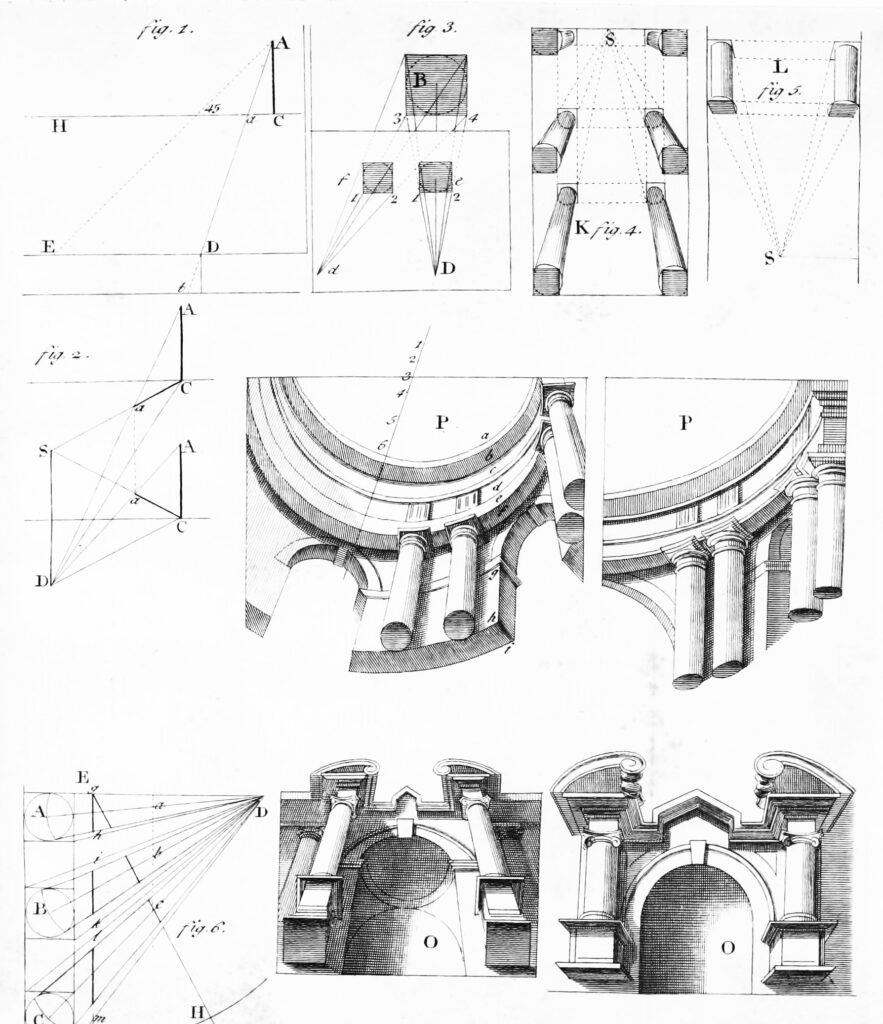
Fig. 1.] Let C H be the Section or Profile of the Cieling, A C a Column, or any original perpendicular Object, of its geometrical Height; C a, being One-third of the Length of C A, is taken to represent it; a being the Representation of A, then, I say, the Spectator’s Eye must be somewhere in the Line A D; and if D is supposed to be the Height of the Eye from the Floor, then D is that Point; for, supposing D E to represent a Line, in which the Spectator’s Eye might move backwards or forwards, it is evident, if C A be represented within the Space C a, that D must be the Place where the Spectator ought to stop. Otherwise imagine the Eye to be removed back as far as E; so that the visual Ray A E may cut the Cieling in an Angle of 45 Degrees; then the painted Object will be equal in Length to its Original (though on the horizontal Plane), and in all Places of D E backwarder than E; i. e. 45 Degrees; the Representation of A C will be longer than its Original, as, in all Places forwarder than E, the Representation will be shorter than its Original. It is of no Consequence whether the Floor be the true Distance, or whether that were taken away, and the Picture seen from the Ground: In both Cases, the Eye must be in some Point of the indefinite Line A D; and so will see a as the Representation of A; for if the Eye were at b, that would make no Alteration in the Perspective Length of C a; as is evident.
Fig. 2.] And now, having found the Point D, or the Spectator’s Eye, it will be necessary, in order to examine the Picture, to suppose the Cieling seen not sidewise, as in the Scheme above, but in Front, over the Spectator’s Head; and, in this View, let C, S, C, be taken for the Plane of the Cieling; and, from S, let S, D, be drawn perpendicular to that Plane below it, and C A, C A, be drawn, of equal Lengths, perpendicular to the same Plane, above it. Now, suppose D, S, the Distance of the Eye from the said Plane, or Picture, of which S will consequently be the Centre, and the Lines S D and C A, C A, will be all parallel to one another (by 6. of the 11. Euclid); then will the Eye see C A, C A, upon the Picture, in the Lines C S, C S, where C a, C a, will will be the Representations of C A, CA; for A D and A D, in this Scheme, are visual Rays, as AD in the former.
But as one principal Error in these Paintings, is the false Direction of the Columns (for they are drawn parallel to the Sides of the Picture, and to each other, instead of tending both to the same Point), it may be proper to consider this Circumstance more particularly. A C, and A C, being thus raised perpendicularly, are in the Position of the original Columns; and D S is drawn parallel to them, cutting the Cieling, or Picture, in S, directly over the Spectator’s Head. Now, supposing the Cieling, or Picture, transparent, it is impossible the Spectator, in this Situation, should see the Tops or Capitals of the Columns in any other Lines or Directions than those of C S, and C S; for each Triangle, C A D, is a Plane cutting the Cieling, or Picture, in that Line C S; the Point C touching it, and the visual Ray D A cutting it in a; and if their Columns were ever so high, even infinitely continued, upwards, their whole Representations would be in the Lines C S, and C S, and their Tops, at an infinite Distance, would coincide with S.
Or thus: The Lines C A, and D S, being parallel to each other, a Plane will pass through them both; and as CA touches the Picture in C, and D S touches it in S, the Plane passing through these Lines will necessarily cut the Picture in C and S; that is, in the Line C, S; and the Line AD is, in this Plane, A C, S D, and (with it) cuts the Picture in the Line CS, their common Intersection; i. e. at the Point a.
Though nothing more is absolutely necessary to the present Purpose, yet the following Demonstration may be acceptable to some Readers.
The Two Triangles C A D, C A D, are equal, being on equal Bases, and between the same Parallels [See Prop. 38. of the First Book of Euclid]; and C S D, C S D, are equal, because on the same Base, and between the same Parallels (Prop. 37.): Wherefore the whole Figures C A a S D, C A a S D, are equal (each being composed of Two Triangles, already proved to be respectively equal); and therefore, lastly, taking away the Two equal Triangles C S D, C S D, the remaining Triangles C A a, C A a, must be equal; and consequently, having equal Bases on the same Line, must be between the same Parallels: For which Reason, C a, C a, are of equal Height; i. e. a Line drawn from a to a will be parallel to one drawn from C to C; and would be so, tho’ the Obliquity, and consequently the Lengths, of C a, and C a, were different, as they must be, when S is not exactly in the middle.
All Representations of Objects, parallel to the Picture, are parallel to their Originals, and consequently retain their geometrical Forms: As for Instance; Circles will always be Circles in their Representations, and Squares will be Squares. Let B (Fig. 3.) be an original Square, with a Circle inscribed, and let e, f, D, d, be a Picture parallel to it; D being the Distance, or Place of the Eye, in this Case the Perspective Representation made by the visual Rays, intersecting the Picture, will be a Square, and the Circle, within, will also be a Circle; nor will these Forms be changed, if the Eye were removed to d, or to any other Point, while the Picture, which is here always supposed parallel, receives the Image by means of the visual Rays intersecting it from the Original; for each Line of the Perspective, or Picture, is necessarily parallel and similar to its Correspondent Original; being formed by a triangular Plane passing thro’ the Plane of the Picture; the Base of which Triangle is the original Line, and the Vertex of it is the Eye: Or thus; The smaller Triangles, D, 1, 2, D, 1, 2, are similar to the larger Triangles D, 3, 4, D, 3, 4; D 1 being to D 3, as D 2, is to D 4, and as 1, 2 is to 3, 4; for D, 3, 4, is a triangular Plane cutting the Picture in 1, 2; which Picture is parallel to the original Square [See 16, and 17 Prop. of the 11th Book of Euclid’s Elements]; and so of every other Line composing the whole Square, and of the whole Circle.
From what has been said above, it is evident, that a Picture on a Cieling, representing such Pieces of Architecture, as those which have occasioned these Reflections, ought to appear as K (Fig. 4.); whereas they are painted as L (Fig. 5.); which does not represent the Thing intended, but something else; for if, in K, the Columns represent Perpendiculars to the horizontal Plane (the Originals of which are consequently parallel to each other), then, in L, they represent Columns diverging from each other at the Top, thus \ /: Moreover, the Plinths of the Bases not being Squares, but Trapeziums, and the Circles not being Circles, but Ellipses, do represent Trapeziums and Ellipses; for, since they are on a Picture parallel to the Originals, they must represent Figures similar, or of the same Forms. It remains only to point out the probable Causes of the Errors here remarked; in order to which it must be considered, as hath been observed, that, when the Picture is a Plane parallel to the original Objects, it will receive their Representations in a parallel Manner; that is, the several Parts will be in the same Proportion to each other as in the Originals: For Instance; they will neither be shortened nor lengthened, but always keep their geometrical Proportions in what manner soever the Spectator’s Eye is placed; but when the Picture makes a right (or any other) Angle with the Original, it will receive their Representations either longer or shorter than such Originals, according to the Situation of the Spectator’s Eye; as hath been shewn at Fig. 1.
Now, the apparent Cause of these Mistakes is a general Notion, that all Objects ought to be represented as they appear to the Eye; which, though in a certain Sense true, is far from being so, as frequently applied to Practice; that is, without considering the Position of the Picture, or Medium through which these Objects do appear to the Eye, whether parallel, perpendicular, or inclined, with respect to the original Objects; the Understanding of which thoroughly, would prevent all possible Errors, as the neglecting, or not understanding this, has occasioned these, and many more.
In the Case before us, the Painter must have considered, that, if he had seen Columns in the Situation in which he has supposed the Originals of these, from the Station which he has chosen, they would appear shortened: And herein he judged rightly; and hath given them a Length suitable to the Plane on which, or Medium through which, they are seen from below; but then he has made the Columns parallel to each other; which they never can be on an horizontal Plane. From hence it appears, that his Mistake is owing to what has been already taken Notice of; viz. not considering the Necessity of finding the Points of Intersection of all the Parts of the Objects, on the same Medium, from one and the same Station.
Again, The Circles and Squares are false, for the same Reason; for though it be true, that a Square or Circle, seen obliquely, will not appear as when seen directly, yet it does not follow (as hath been remarked), that they must not be represented by Squares and Circles; on the contrary, they are to be represented by similar Figures; for the Obliquity of the Spectator’s Situation, in respect of the Painting, being exactly the same as in respect of the Original, will produce the same Effect; i. e. in both Cases, the Image in his Eye will be the same: So that, tho’ it be not true, that all Objects are to be represented, in all Cases, as they appear (without regard to the Medium through which they are seen); yet it is true, that all Objects are to be painted so, on the Medium through which they are seen, or supposed to be seen, as that they shall appear, as the Originals appear.
For want of these Considerations, or want of sufficient Knowlege, the Painter hath represented the Objects here, in some Circumstances, as on an horizontal Plane; in others, as if on a perpendicular Plane; in such manner that the Pictures are false on any Plane whatsoever; and eminently so on the Plane where they are.
Tho’ it is presumed, that what has been undertaken is sufficiently proved; yet since it might be expected, that those Pieces of Architecture, which are condemned, should be exhibited as, it is pretended, they ought to have been painted; to satisfy such Curiosity, they are added, both as represented on the Cieling, and also as they ought to have been represented: But, in the First, marked O, O, the Wreathing of the Columns is omitted, to shew the Perspective more nakedly; and, as they are mere Sketches, Regard is had only to the Perspective.
The Squares of the Bases of the Pedestals, in the First, are left visible, to shew the Effect, and convince the Reader of their Truth; tho’ otherwise they ought to be supported, appearing here in the Air.
In the Second, marked P, P, the Columns are supposed cut asunder, for the same Reason; that is, to shew the Circles.
The Reader will judge better of the Effect, by holding the Prints over his Head, for a few Moments.
And tho’, in this small Treatise, the Principles, in general, were only intended to be ascertained, and not the Practice; which latter is amply and explicitly taught in a larger Work; yet, that the Second Figure may be more readily understood, and the Operation comprehended, let it be observed, that the Line, marked 1, 2, 3, 4, 5, 6, is the Axis of a Cylinder, and the numerical Figures are Centres of the several Circles; each of which is a Plane parallel to the Picture: For Instance, Nº 1. is the Centre of the Circles a and b; which are considered as concentrical; 2 is the Centre of c, – 3 is the Centre of d, – 4 is the Centre of e and f; which are concentrical; – 5 is the Centre of g; – and 6 is the Centre of h and i; which Circles are also concentrical.
The same Principles, and the same Kind of Reasoning, will determine the Question, Whether, in representing a Row of Columns, standing on a Line parallel to the Picture, those which are more distant from the Centre of such Picture, should be made equal to, less or bigger than, the nearer? It is allowed they appear less; but the Answer to this Question is, that they ought to be made bigger; and, though so painted, they will really appear as much less as they appear in Nature: For (Fig. 6.) let A, B, and C, be Three Columns, either square or round; and first suppose them square; it is evident, that the Representation of them will take up the Space marked by the visual Rays, from the extreme Angles to D, the Spectator’s Eye, on the Line E F, which may be considered as the parallel Picture; that is, the Representation of A will fill the Space g, h; that of B will fill the Space i, k; and that of C, the Space 1, m.
If the Columns are round, the several Spaces, which their Representations employ, will be determined by the Rays which are Tangents to the Circles: These Spaces are marked with a double, or blacker Line: But if the Picture be placed on the Line E, H, or any other Line between H and D (the End E remaining unmoved), the Representations of the more distant Columns will then be in less Spaces of the Picture, in certain Proportions, according to their several Distances: But, on all these Pictures, they will be truly represented, and will exhibit the Images of the Originals to the Eye of the Spectator at D; who will necessarily form the same Ideas of the Proportions and Distances of the Objects from any one of these Pictures, as from any other of them; which may all be considered as transparent Planes, or as one such Plane moveable on a Hinge, at E, from F to H, or to any other Point on the Arc F H; which Plane or Planes (being supposed transparent) no more hinder the Spectator from discerning the original Objects than the common Medium of Air; and as all the visual Rays are necessarily right Lines, the Picture, or Medium, makes no Alteration in their Directions; which are continued, without Interruption, from the several Parts of the Originals, to D, through one or more transparent Planes, however placed; and, whichsoever be chosen, the Representations can be determined by nothing but the Intersections of those visual Rays, and cannot possibly be false, if these Intersections are truly found. And since every Reader, even the least intelligent, will readily allow, that the Representations on the Picture E, H, must truly exhibit the Images of their Originals; a little Attention, and Reflection, will also convince him, that those on the Picture E, F, must necessarily exhibit them with equal Truth, because they are determined by the very same Rays. But as something of this Kind has been already said, in the Examination of the Banqueting-house, no more need be here added.
N. B. The Rays for the round Columns are determined by making Tangents to the several Circles from D, and the Points in which they touch are found, by bisecting the Line from D to the Centre of each Circle; that is to say, the Lines D A, D B, and D C, and with the Lengths a A, b B, and c C, as Radii, making an Arc through the Centre of each Circle, cutting the Circumference in the Points sought.
If the Circles were nearer each other, and D at a greater Distance, the Difference would be proportionably less, and, at a sufficient Distance, not at all offensive; as indeed nothing, that is truly represented, can be; but even at this, or any Distance, the Rule (being demonstrably and universally just) cannot vary.
FINIS.