
Bardwell 1756
Thomas Bardwell, The Practice of Painting and Perspective Made Easy: In which is contained The Art of Painting in Oil, with the Method of Colouring, London [Thomas Bardwell – Andrew Millar – Robert and James Dodsley] 1756.
Thomas Bardwell (1704–1767) was an English portrait painter and copyist. He is the author of a successful painter’s manual published in 1756. Among other topics, the book includes a list of the principal pigments. At the end of the second part, devoted to perspective, Bardwell criticises Joseph Highmore’s treatise on Rubens’s paintings on the ceiling of the Banqueting House in London.
p. 7–9
Of the principal COLOURS used in the Flesh, from which all
the Teints are made.
Flake-White
1. FLAKE-WHITE, or FINE WHITE, is the very best White we have. This Colour should be ground with the finest Poppy Oil than can be made. At present our White is bad, on account of the Oil, which is not really Poppy. White is a friendly working Colour, and comes forward with Yellows and Reds, but retires with Blues and Greens. It is the Nature of all Whites to sink into whatever Ground they are laid on; therefore they should be laid on white Grounds.
Ivory-Black
2. IVORY-BLACK is the best Black we have: It is a Colour which sympathizes and mixes kindly with all the other. It is a true Shade for Blue. Ivory-Black and a little Indian Red make the best general Shadow-colour that can be. It is ground with Linseed Oil, and used with drying Oil. Black is a cold retiring Colour.
Ultramarine
3. ULTRAMARINE is the finest Blue in the World. It is a tender retiring Colour, and never glares; and is a beautiful glazing Colour: It is used with Poppy Oil.
Prussian Blue
4. PRUSSIAN is a very fine Blue, and a kind working Colour. It is ground with Linseed Oil, tho’ I think Nut Oil is more proper. It should never be used in the Flesh, but in the green Teint, and the Eyes.
Light Oker
5. LIGHT OKER is a friendly mixing Colour, and of great Use in the Flesh: It is usually ground with Linseed Oil, but Nut Oil is better. All Yellows are strengthened with Reds, and weakened with Blues and Greens.
Light Red
6. LIGHT RED is nothing but fine light Oker burnt: This and White in mixing produce the most perfect Flesh-colour that can be made. It is a beautiful, clean, kind, working Colour; but too strong for the White; and therefore will grow darker. It should be ground and used with Nut Oil.
Vermillion
7. No VERMILLION, but what is made of the true native Cinnabar, should ever be used. It will not glaze; but is a fine Colour when it is glazed. It is ground with Linseed Oil, and should be used with drying Oil.
Carmine
8. CARMINE is the most beautiful Crimson that can be: It is a middle Colour between Lake and Vermillion; is a fine working Colour; and glazes delightfully. It should be ground with Nut Oil, and used with drying Oil.
Lake
9. LAKE is a tender, sympathizing, deep Red; but of no strong Body; therefore it should be strengthened with Indian Red. It is the best glazing Colour that can be used. It is ground with Linseed Oil, and used with drying Oil.
Indian Red
10. INDIAN RED is a strong, pleasant, working Colour; but will not glaze well; and when mixed with White, falls a little into the Lead. It is ground and used as the Lake.
Brown Pink
11. BROWN PINK is a fine glazing Colour; but of no strong Body: In the Flesh it should never join, or mix with the Lights; because this Colour and White antipathize, and mix of a warm dirty Hue; for which Reason their Joinings should be blended with a cold middle Teint. In glazing of Shadows, it should be laid before the other Colours, that are to enrich it: It is one of the finishing Colours, and therefore should never be used alone in the First Painting. It is strengthened with burnt Umber, and weakened with Terraverte; ground with Linseed Oil, and used with drying Oil.
Burnt Umber
12. BURNT UMBER is a fine warm Brown, and a good working strong Colour: It is of great Use in the Hair, and mixes finely with the warm Shade.
THE
PRINCIPLES of PERSPECTIVE
. . .
pp. 56–64
PLATE VI.
THIS Picture is the Representation of a large Block of Stone, whose Angles are square, like those a Cube. It stands on one of its Edges on the Horizontal Plane, and is supported by another Block. The Line C P, is the Seat of the Edge it stands on; and C V is the Seat of the Side R. Its Angle of Inclination with the Horizontal Plane is equal to the Angle V E H. Therefore H is the Vanishing Point of its Inclination.
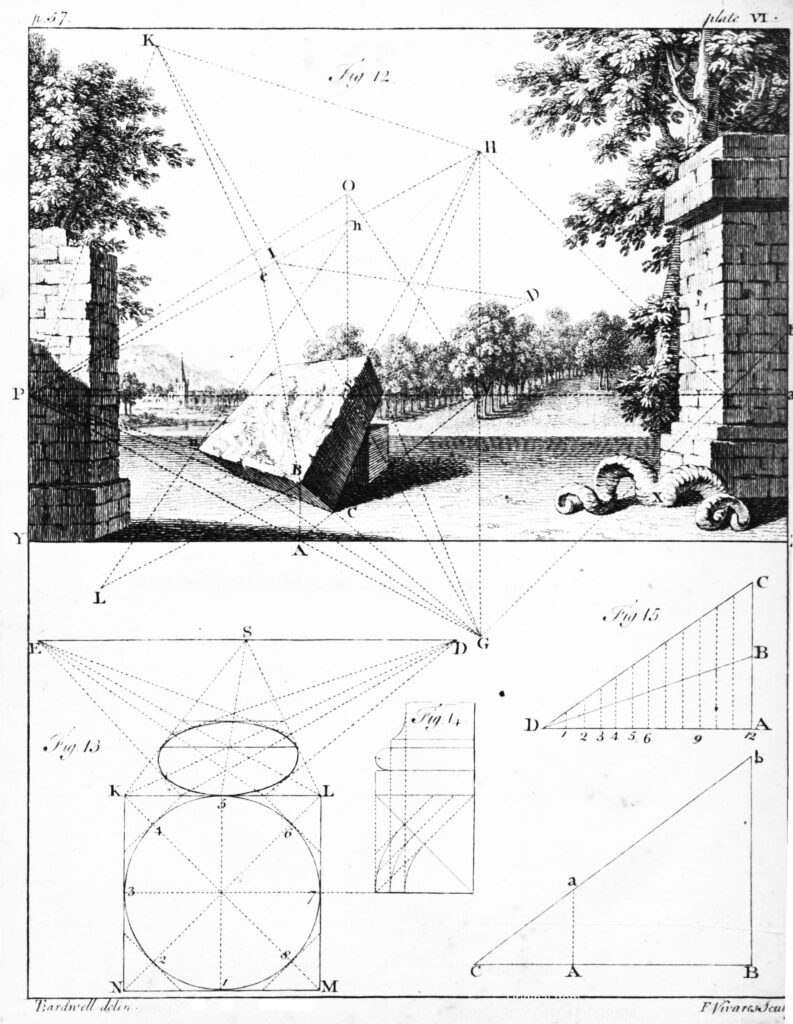
FIG. 12. Let Z Y be the Base-Line, PE the Horizontal Line, S the Point of Sight, S O the Distance of the Picture, and P the Vanishing Point of the Edge the Block stands on.
First we must find V, the Vanishing Point of Lines that are perpendicular to the Point P; thus: Draw a Line from P to the Eye-point O, and make O V perpendicular to the Line OP, which gives the Vanishing Point V: Then will V be the Vanishing Point of the Seat of the Side R; which Side is in a vertical Plane, whose Vanishing Line passes thro’ V in that Direction: Therefore V is the Vanishing Point of the common Intersection of the Vertical and Horizontal Planes. Draw the Vanishing Line G H; then will V be its Center, and V O its Distance. Make V E perpendicular to the Vanishing Line G H, and equal to its Distance V O: Then at the Point E make the geometrical Angle of Inclination, as V E H, which gives H the Vanishing Point of the Inclination. Draw E G perpendicular to E H, which makes G in that Vanishing Line the Vanishing Point of Lines perpendicular to H. Next draw the Vanishing Line P H, and make S D parallel to it, and equal to the Distance of the Picture; then, from the Point of Sight, draw a Line to cut the Vanishing Line P H at right Angles; which gives I the Center, and I D the Distance, of that Vanishing Line.
Here it is obvious in this Projection, that the Lines P H, G H, and P G, are the three Vanishing Lines of the several Faces of a Figure, which contain a solid right Angle.
It is also very plain, that the Line E H, according to these Rules, must be the geometrical of the original inclined Plane: Therefore, if we make E b equal to the End or Thickness of the Block, then will a, be the Seat of b, as on the Horizontal Plane.
To proceed with the Projection: Make A B in the Plane of the Picture equal to ab; then will the Point B be the nearest Angle of the Block.
Next we should make I K equal to I D, and draw the Lines P K, and H K, that generate a square Angle, which is equally divided by the Line K e. Make B L equal to the Length of the Block, and parallel to the Vanishing Line P H. Draw a Line from L to h, the Distance of P; which will give the Side Bn. Draw n H, and the Diagonal B e, and thro’ their Intersections draw a Line from P, which gives the upper Side. Next draw the Line B G, which gives B C, the nearest Edge; and draw the Lines B P, C P, and B H, C H; then the Line n G, and one from the Angle above S to G, will finish the whole Representation, or Projection of the Block.
I have endeavoured to shew, in the Progress of all the Schemes, that the Principles, on which the whole Art depends, are so simple, that it is obvious the Method is general to all Planes alike.
First, of the Horizontal Plane. The Distance of the Picture must be placed from the Center, or Point of Sight, perpendicular to its Vanishing Line, before we can make the generating Angles, which give the Vanishing Points: Then we may bring down their Distances to the Horizontal Line, provided the Dimensions of the Original are brought parallel to them; as I have shewn in the Course of the Work.
Secondly, of the Vertical Plane. The Distance of the Vanishing Line is placed perpendicular to it; and from the Eye-point proceed the generating Lines that give the Vanishing Points: The Distance of which are used and brought to the Vanishing Line in the same manner as those of the Horizontal Plane.
And the Inclined Plane has its Distance placed perpendicular to the Vanishing Line; and from the Eye-point proceed the generating Lines and Angles, which produce the Vanishing Points, and which are also brought to the Vanishing Line, and used as those of the Horizontal.
The Method of finding the Center of a Vanishing Line, is, only to draw a Line from the Point of Sight, to cut or intersect the Vanishing Line at right Angles; which Intersection will be the Center of that Vanishing Line. The general Rule for finding the Distance of a Vanishing Line, is, always to make the Distance of the Picture from the Point of Sight parallel to that Vanishing Line, and to draw a Line from that, to the Center of the Vanishing Line, which will be the Distance of that Vanishing Line, as D I is to the Vanishing Line P H, or O V to that of G H.
To find the perspective Representation of Circles, we are obliged to make a Plan of the Circle, or Part of the Plan; by adding such Lines to it, as may easily be projected, and leave a clear Idea of the required Circle.
FIG. 13. Let S be the Point of Sight, D and E the Points of Distance, and K L M N the Scheme of the Plan.
The most exact and easiest Method, is, to inclose the Circle with a Square, and then make the two Diameters and Diagonals, which give the eight required Points. But instead of drawing Lines thro’ the Points of the Diagonals parallel to the Sides of the Square, I make them parallel to the Diagonals: This Method gives the same Points, with the Lines nearer to the Circle than can be drawn by any other Method whatsoever. The rest of the Figure needs no Demonstration.
FIG. 14. Shews the Method of making the Plan of the Circles, in order to find the perspective Representation of the Torus; which I have done according to my Method, just shewn, of drawing Circles; and which may be understood very easily, at Sight of this Figure.
The Perspective of the Torus seems to be a Circle contained in four Lines, which are nearer or farther distant from each other, according to the Situation of the Eye: Two of which are perpendicular to the Horizontal Plane: These give the greatest Breadth of the Torus; the other two are parallel to that Plane, and give the Height and Depth: The one is the upper and farthest Part of the Circle, the other the nearest and bottom Part of the Torus. The two perpendicular Lines proceed from the Extremity of the Circle in the Plan, which are found from the Projection of the two eight opposite Parts: Those that give the Height and Depth are governed by the Perspective Section of the Base, which is in the Vertical Plane.
FIG. 15. Is the Diagonal Scale; which is of universal Use for transferring all Sorts of Designs to the greatest Exactness, and so easy to understand, that one Demonstration is sufficient for every Artist; who will, I imagine, find no manner of Difficulty in applying it to Practice. Suppose A B to represent one Foot in the Design which we are to work from, and A C to be the intended Length of one Foot in that which we are going to make.
The Method is, first to take the Dimensions of the Part we propose to begin with; then to place the Compasses to the Base-Line of the Scale, and find what it is in the Line D B; then open them to that in the Line DC, which will be the required Length.
Thus the Representation is found by Feet and Inches; because the Base-Line D A contains twelve Parts, which consequently divide the Length A B, and A C, on the Lines D B, and D C, into that Number.
By this Method we may make the Scale to any Proportion: And as it is the Business of every Artist to find a proper Scale for his Purpose, therefore Painters are not obliged to use always such Scales as the Work was wrought to.
Suppose we draw the Pedestal without using the Method of Feet and Inches: Divide the whole Height into any convenient Number of equal Parts, and let one of those be for the Scale: Then divide the Height we intend to make the Pedestal of, in the same manner, and apply them to the Method of the Scale; which will answer our Purpose as well. It is sometimes necessary, in copying, to divide the Original into a Number of Squares, and then divide the Cloth for the Copy the same. If in one of the Squares at the Corner of the Cloth we make the Scale according to this Method, we may use them as we did the Scale of Feet and Inches.
The Number in the Base of the Scale is at our Pleasure. Remember to make the Squares very large; for none but Novices make them otherwise.
FIG. 16. Is a Method which I have often found to be of great Use, and very easy to practise, when we are a little used to it.
Suppose the Line Aa, to be the Height of any Design we have to work from; and the Line Bb, the intended Height of that which we are going to make. Draw the Base C B, then place the Design perpendicular to it as A a, B b, &c. and draw a Line from b through a, to cut the Base, which will give the Center C.
If the Line A a, be divided into any Number of Parts, and we draw Lines from the Center C through them, to cut the Line Bb, then will they divide the Line Bb in the same Manner exactly.
Therefore if the Line A a, was the Axis of a Column and Entablature, the same may be transferred to the Height we would have it, by having a small Nail in the Center, and a fine Thread, such as the Wig-makers weave with, and only strain the same over the Parts in Aa, to Bb, which will give the required Dimensions.
In the same Manner we may have all the Breadths, by applying them to the Line A a, and continuing them to the Line B b; or if it is only a few of them, as the Diameters, they may be done separately: But remember, that after the Places of the Lines A a and B b are fixed, they must continue so, till the Whole is finished.
The antique Figure in the sixth Plate, marked with the Letter X, is an Object I have studied with great Application and Care, in order to project it exactly, according to the Rules of Perspective; and as I improved in the Knowledge of the new Principles, I flattered myself I should succeed; believing if I arrived at such Perfection in the Art, I should then be able in time to represent all Objects whatsoever, as some of the Learned in the Mathematicks will have it, according to the strictest Rules; who dogmatically assert that every Part of the Perspective should be mathematically true. When we fancy this to be really the Case, it is reasonable to believe that we should be anxious to learn an Art, which we think so absolutely necessary. Now, gentle Reader, I must confess my Weakness, and tell you, that notwithstanding all my Care, and puzzling after this mathematical Truth, I find the Undertaking was too great for my Capacity; and therefore, from the Experience of my Folly, I determined to give up the Attempt, and flatter myself no farther with such Expectations. But whenever the Rules which I have shewn, should fail, and grow tedious, which I believe will not happen in Matters of Consequence, I design immediately to settle the Affair at Sight of the Object.
The Volutes in the Capitals of Columns, and the Twist in Stair-cases, are Objects of this Nature, and very probably were taken from this Antique. It has also a great Resemblance to Mr. Hogarth’s precise Serpentine Line; and therefore, without doubt, has some Grace, though the Twist is a little quicker. It is an Object of well-varied Contents, whose Proportions gradually lessen to its Extremities; and its Dimensions are governed by Fitness, Variety, Uniformity, Simplicity, Intricacy, and Quantity. What a Pity it is, this venerable Object of Antiquity should not be represented by the strictest Rules of Perspective! I confess this would afford Matter of Triumph to any learned Critic, that is happy enough to succeed in the Attempt.
In pursuance of our present Inquiry, suppose, according to a certain chimerical new System, the Object under our Consideration be imagined to have all its inward Contents nicely scooped out, and the Eye at once to view the Whole from within, and mark the opposite corresponding Parts, and take Care to acquire a perfect Idea of the Distances and Bearings of their several material Points and Lines in the Surfaces: Or, for the more easy Description of the Projection, suppose we were to gauge the Contents with Wires, in order to assist and guide us to a readier Conception of all the intervening Parts; I leave it to the Critics to judge of what Use these Expedients are, towards raising in the Imagination a true and perfect Idea of the Antique in Question.
The Pamphlet intituled A critical Examination of the Paintings on the Ceiling of the Banqueting-house at White-hall, shews that that celebrated Ceiling has nine separate Points of sight: And that no Painting can appear perfectly true, unless seen from the Point intended by the Painter: And though a Picture may be perfectly true from one certain Point of View, it cannot from any other. Therefore the Author has taken great Care, to shew the Necessity of regarding a Picture, as intended by the Painter.
The Picture he says, being always considered as a transparent Surface or Medium, through which the Visual Rays are supposed to pass; if the Spectator changes his Situation, those Rays (in Nature) will intersect that Surface in different Points; and therefore (in the Picture) being determined to such certain Points, the Station of the Spectator becomes necessarily fixed and unalterable, and the Picture must appear false seen otherwise.
Suppose we fee, through a Window or transparent Plane, a real Cube, placed directly opposite, tho’ somewhat below, the Eye. In this Situation we shall fee only two Faces, one in Front, and the other at Top; and if we move to the Right or Left, we must see one of the other Faces. This is his Proposition; which is certainly true.
In order to understand the Principles of Perspective, we are obliged to consider the Picture as a transparent Plane, thro’ which the visual Rays pass to the Spectator’s Eye. But when the Design is really a Picture, whose Representation is fixed upon some opaque Body, as a Board, Wall, or painted Cloth, that cannot be transparent, but a flat smooth Surface; and the Object represented is a Cube that shews only two Faces, one in Front, and the other at Top; tho’ we move to the Right or Left from the Point of Sight, we shall never fee more by changing the Place; neither is it reasonable to believe we should : For if we find the same Appearance, tho’ moved from the Point intended by the Painter, the Case is not altered; which shews there is no Necessity of having the Eye of the Spectator exactly in that identical Point .
If the Spectator’s Eye must coincide with the Point of Sight, the Distance should be considered accordingly; and it will then be a very difficult Matter to come at the proper Point of View to fee the Picture; and the more so, as its Horizon, when hung up, is seldom so low as the Eye.
I own the Sight of the Pamphlet excited my Curiosity to examine the Ceiling; and I find the Centre of the Whole to be the only Point of Sight requisite in all that noble Design. For, from the Middle of the Room, I saw the Intention of that great Painter, and was convinced of it from the Order of the Whole, and by the natural Position of the Figures, which appeared all finely foreshortened, and looked like such living Objects viewed from the middle of the Room below, which was, in my Opinion, the principal Point of View that Rubens intended for the whole Ceiling.
I am also of Opinion, that all Ceilings, except those of Galleries or long Rooms, should have but one Point of Sight; and, that there are some Subjects, which I believe require no Point of Sight, as living Objects represented in the Clouds, which have no Architecture, nor any terrestrial Appearance; which is the Case with most of the Work in this Ceiling. And if there is no Point of Sight required in the Work of the Picture, then I think there is none in regard to its being truly seen; because the Eye cannot coincide with the Point that never was made or intended.
It was not material to take Notice of the most dry and lifeless Part of the Performance; I expected Mr. Highmore would have given us some ingenious Remarks on the Foreshortenings of the Figures, and of the Excellence of the Colouring, which I presume would have been more agreeable to his Readers, than telling them, that Rubens was a little deficient in an Art which was never understood, as he might have said, till this Century. But it is reasonable to believe, if his Leisure had permitted him to examine the Whole, he would have found much to commend, and very little to censure.
As it may be expected, that I should say something of the Perspective of Shadows, I shall only observe, that the Geometrical or Perspective Knowledge of Shadows is of very little Consequence to a Painter; it is easily understood, when we have learned that of the Objects. But in my Opinion Painters may spare themselves the Trouble of learning the lineal Perspective of Shadows, because their Business is to shun every thing of that Nature in a Picture. All the Limits and Shapes of Shadows should vanish; every Part that is hard and edgy cuts and offends the Eye.
Having now given my Readers the best Insight in my Power to the Practice of Painting and Perspective, I hope they will excuse the Size of this Treatise, which it has been my Study, from its first Projection, to confine to as narrow Limits as possible, being from Experience convinced, that an Art (if properly) cannot be too concisely described: Therefore I am sorry I could not, from the Nature of the Subjects, reduce it to a shorter or lesser Work.
FINIS.